The HR system
you can just ask.
People, attendance, payroll, hiring and performance on one record — with an AI layer that answers people's HR questions from their own record and prepares the request instead of pointing at a form.
30 minutes · your policies, your edge cases · no deck
- Statutory payroll
- Sign in with Okta or Entra ID
- Biometric attendance
- Night shifts across midnight
- KRA & KPI scorecards
- Anonymous 360 reviews
- Nine-box calibration
- Sales incentives
- Full & final settlement
- Exit clearance
- Leave accrual & carry-forward
- Requisition to offer
- Asset register
- SLA-backed helpdesk
- Attrition reporting
- Approval chains
- Row-level permissions
- Audit trail
- Slack notifications
- iOS & Android
Ziva · the AI layer
Stop teaching people where the button is.
Most HR software fails at the last mile: the answer exists, but it is four screens deep and nobody looks, so the question becomes an email to HR. Ziva answers the questions people ask about themselves, from their own record, with the same figures the screens show.
- Grounded in your workspaceYour leave policy, your holiday calendar, your payslips — the rules your workspace configured, not a generic model guessing at HR.
- Scoped to the person askingEvery tool reads the asker's own record and nothing else. There is no argument that names a colleague, so there is nothing to talk it into.
- It proposes, you confirmAsk for leave and Ziva prepares the request. It is filed when you press Confirm, on a route the model cannot reach.
YouHow much casual leave do I have, and how much notice does it need?
ZivaYou have 4.5 casual leave available — 6 allocated, 1 used, 0.5 held by a request still awaiting approval. Casual leave needs 1 day's notice and allows half days, up to 3 consecutive days.
YouWhy was my August payslip lower than July's?
ZivaTwo unpaid days. Your August record shows 2 days loss of pay on the 11th and 12th, which took ₹3,870 off basic and HRA. Everything else — PF, professional tax, allowances — matches July.
YouPut in leave for the 14th to the 16th.
ZivaThat is 2 working days — the 15th is a holiday at your location — and it fits your balance and notice rule. I haven't applied. The request is on the card below; it goes to your manager when you press Confirm.
Two interfaces, one product
Your CFO and your 23-year-old designer should not have to like the same UI.
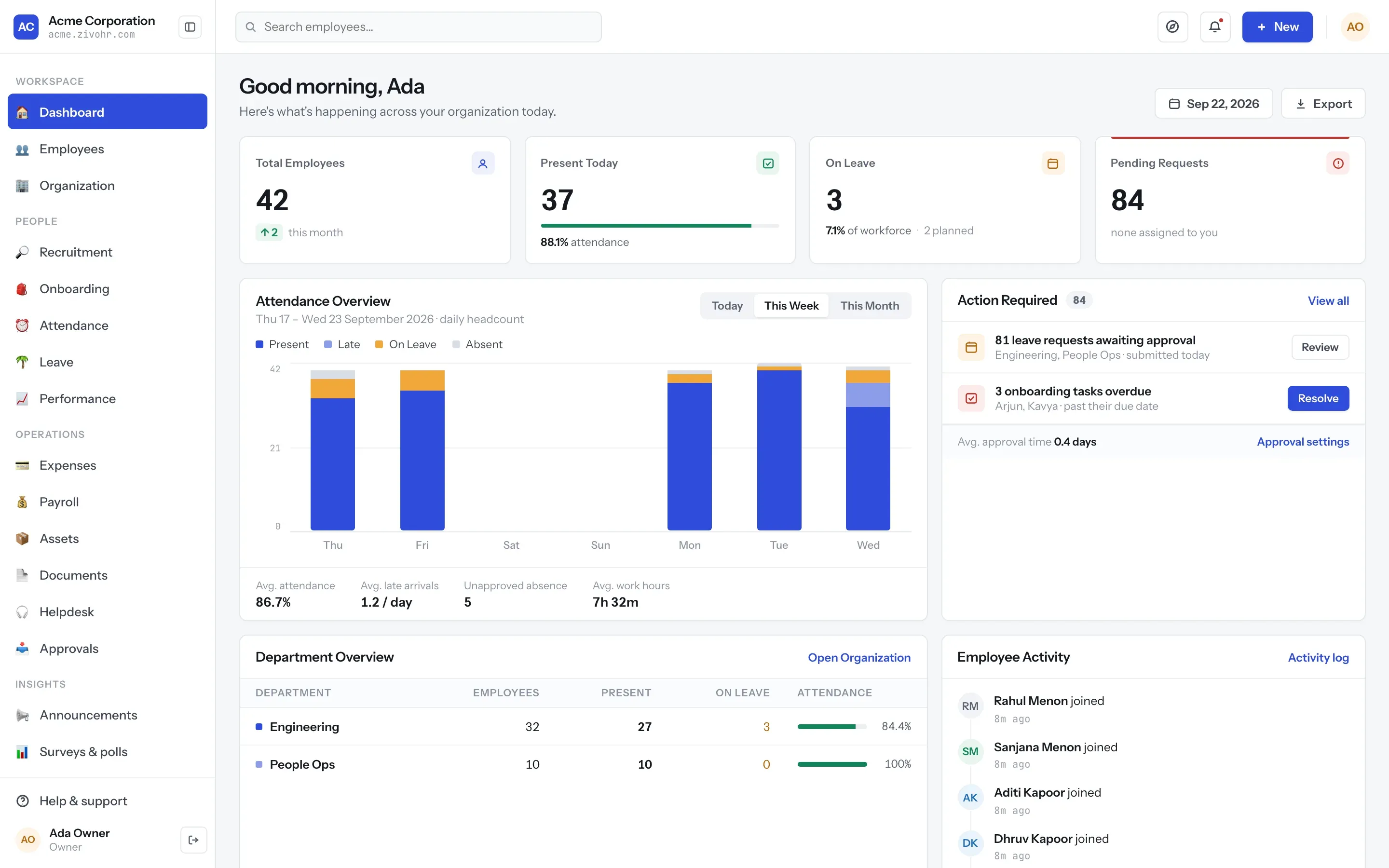
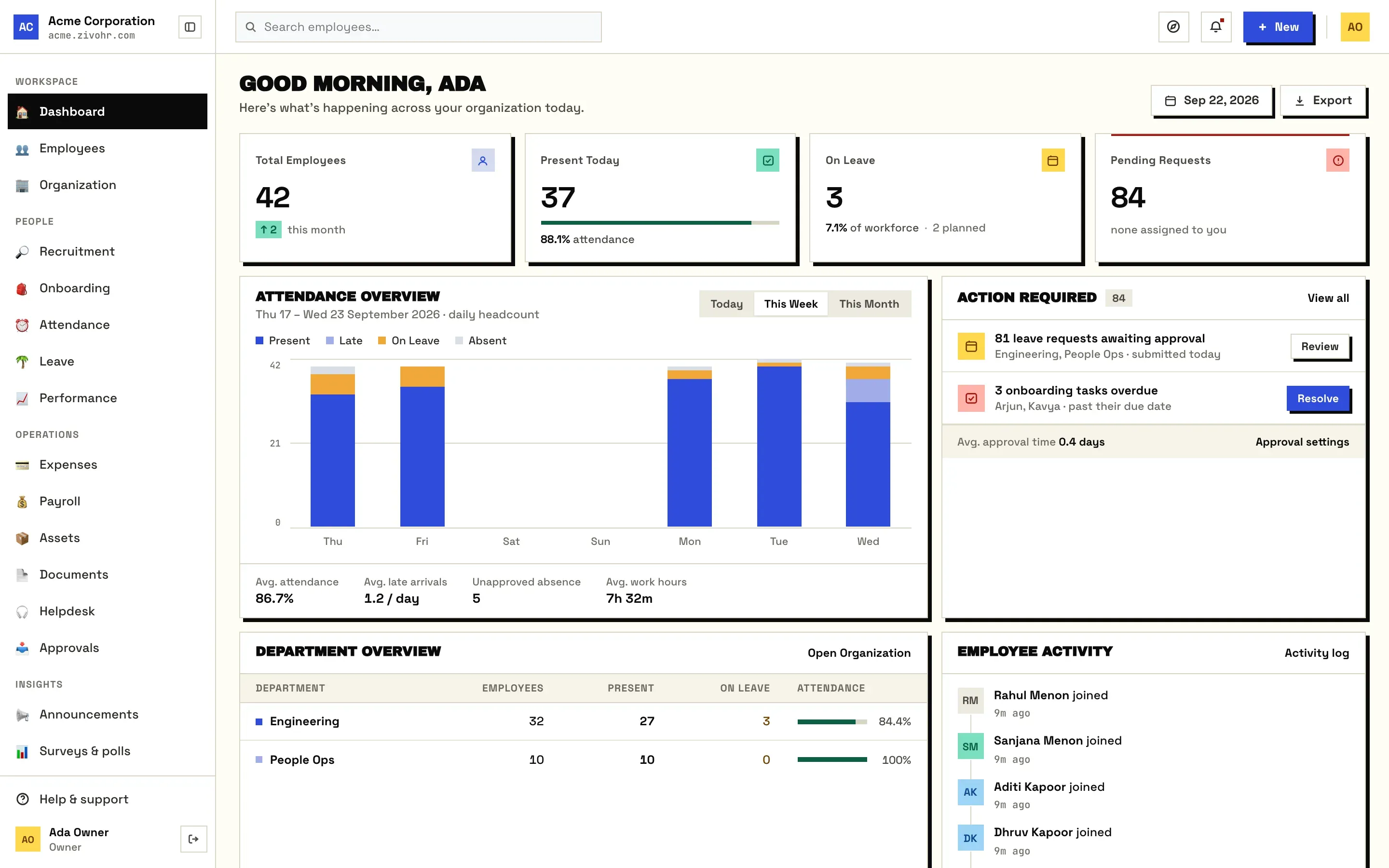
ZivoHR ships two complete interface styles and six colour schemes. Classic is quiet and editorial. Gen-Z is neo-brutalist — ink borders, hard shadows, cream paper. Both are the same components reading the same tokens, so nothing is a re-skin that lags behind. Pick per workspace, or let each person pick for themselves.
Drag the handle. Same data, same components — only the token layer changed.
One token layer
Colour, type, radius and shadow are all custom properties. A skin redefines them; no component knows a skin exists.
Six colour schemes
Primary, secondary, accent and the page background move together — including a full dark scheme. Set it once for the workspace.
Instant, no reload
Switching writes one attribute. Every surface, border and shadow repaints on the same frame.
The platform
Ten modules that actually know about each other.
The reason HR stacks leak is that the tools do not share a record. Here, attendance feeds payroll, the hire becomes the employee, and the approval that clears a claim is the same engine that clears a leave request.
Ziva, the AI layer
Ziva answers from the asker's own record — leave, payslips, attendance, expense policy — and prepares the request for them to confirm.
Learn morePayroll
A deterministic calculation engine with PF, ESI, TDS, PT and gratuity modelled as rules — not as spreadsheet formulas someone has to maintain.
Learn moreAttendance
Every punch — device, mobile, web — lands in one timeline, on the clock of the office it happened in, and feeds payroll without a re-key.
Learn moreLeave
Accrual, carry-forward, encashment and holiday calendars per location, on the same approval engine as everything else.
Learn morePeople & org
Employees, locations, departments, teams, designations and reporting lines — the spine every other module reads from.
Learn moreRecruitment
Jobs, candidates, stages, interviews and offers — and the hire becomes an employee record without anyone retyping it.
Learn moreOnboarding
Task templates, document collection by signed link, asset handover and approvals — and an exit clearance that has to close before the final settlement can.
Learn morePerformance
Weighted KRA and KPI scorecards, anonymous 360 reviews with a floor under them, and calibration on a nine-box grid that locks when it is signed off.
Learn moreExpenses & assets
Claims with line-level approval, per-km and per-day categories priced by the server, and the laptop register nobody wants to keep in a sheet.
Learn moreHelpdesk & comms
An SLA-backed HR helpdesk, targeted announcements and pulse surveys with a results dashboard, so employee voice is data.
Learn moreApprovals engine
One reusable Request → Approver → Decision → Action chain behind leave, expenses and onboarding. Configure it once.
Roles & permissions
Permission codes, not job titles. Row visibility follows the reporting tree: own record, my subtree, or everything.
Single sign-on
Okta, Microsoft Entra ID or any OpenID provider. It signs existing people in and never signs strangers up.
Reports & exports
Attrition as a rate over average headcount, and audit-logged CSV exports that are safe to open in a spreadsheet.
Audit trail
Every consequential write is recorded with actor, tenant and source IP. Exportable, immutable, boring on purpose.
Announcements
Targeted by location, department or role, with read receipts — so 'nobody told me' stops being a defence.
Payroll, three countries
The run is a function, not a spreadsheet.
One engine, per-country rules — each a versioned, testable definition rather than a formula copied between files. Incentives arrive priced from KPI achievement, and a leaver's full and final is one statement that nets only what it pays.
India
UAE
United States
September 2026 · variance
Built to be audited
Multi-tenant is a security property, not a feature.
Row scoping lives in the data layer, not in each view — a query with no tenant bound raises rather than returns. Permissions are codes, not job titles. Every consequential write lands in an audit log with actor, tenant and source IP.
Isolation that fails closed
Scoping is enforced by the model manager. Forgetting it is an exception, not a leak.
Role-based, row-level
Own record, reporting subtree, or everything — decided by role, checked on every read and write.
Complete audit trail
Who changed what, when, from where. Exportable, and never edited in place.
Your data stays yours
Files stored per workspace and served only by signed short-lived URLs. Provider secrets encrypted and never shown again.
Shipped in September
What landed this month.
The product moves every week. These are the pieces big enough to change how a month closes, each one described on its module page.
Single sign-on
Okta, Microsoft Entra ID or any OpenID provider, on the web and the phone. It never creates an account.
Learn more360 and calibration
Anonymous peer reviews with a floor of three, and a nine-box grid that locks on sign-off.
Learn moreIncentives and full & final
Payouts priced from KPI achievement, and a leaver's settlement that nets only what it pays.
Learn moreAttrition, as a rate
Exits over average headcount, month by month, by department, exit type and tenure.
Learn moreWriting
Notes from building it.
Expand, then contract: shipping schema changes without a maintenance window
During a rolling deploy, the old release and the new one share one database for a few minutes. Adding a column is invisible to old code. Dropping one takes every old container down — so we made the deploy refuse to run destructive migrations.
28 Aug 2026 · 7 min readEngineeringWhy tenant scoping belongs in the model layer, not the view
Every multi-tenant leak we have seen started the same way — a query that forgot which customer it was for. The fix is not more discipline. It is making the forgetful version impossible to write.
12 Aug 2026 · 6 min readPeople opsYour leave policy is a program, and someone is running it by hand
Accrual, pro-rating, carry-forward caps, lapse dates, encashment, per-location holidays, half-days. Every line of a leave policy is a rule, and in most companies a person executes all of them in a spreadsheet every month.
24 Jun 2026 · 7 min readBook a demo · 30 min
See it on your own numbers.
Thirty minutes, your policies, your payroll edge cases. We will show you the parts that usually break.