Scored on the KRAs
you agreed. Calibrated in the open.
KRA and KPI scorecards with the weightages HR actually uses, review cycles and ad-hoc reviews, 360 feedback that stays anonymous, and a calibration room with a nine-box grid. Underneath all of it, the authorization that decides who may write what about whom.
KRAs and KPIs
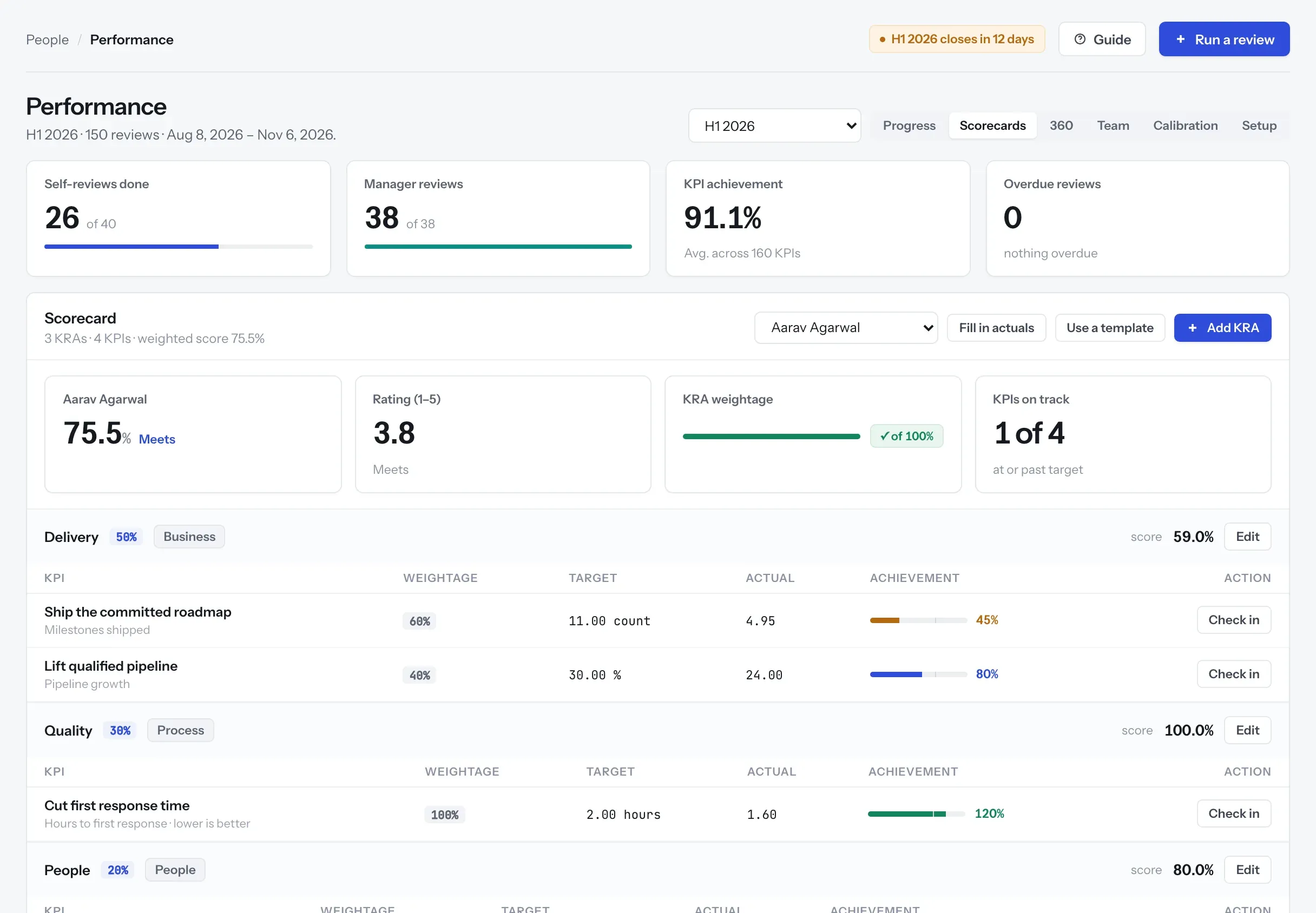
A scorecard, weighted the way HR weights it.
Start from a template for the role, then adjust. Each KRA carries a weightage and the KPIs that measure it. The review form is built from the subject's own KRA tree, so a reviewer scores the areas that person was actually set.
- Lower is better, scored properlyAttrition, defects, cost per hire. Hitting the target is 100%, halving it is 150%, zero is 200%. It is scored linearly from the target rather than by dividing into it, so a perfect month cannot divide by zero.
- A blank is not a zeroA KPI nobody has reported against has no achievement at all. It does not score 200% for an attrition figure nobody counted.
- The team view a manager needsThe team's average, its weakest KRA, and how the team spreads across rating bands, on one screen.
Scorecard · Account manager · H1
Weights 100%Cycles, and everything outside them
Launch it once. Run it as one flow.
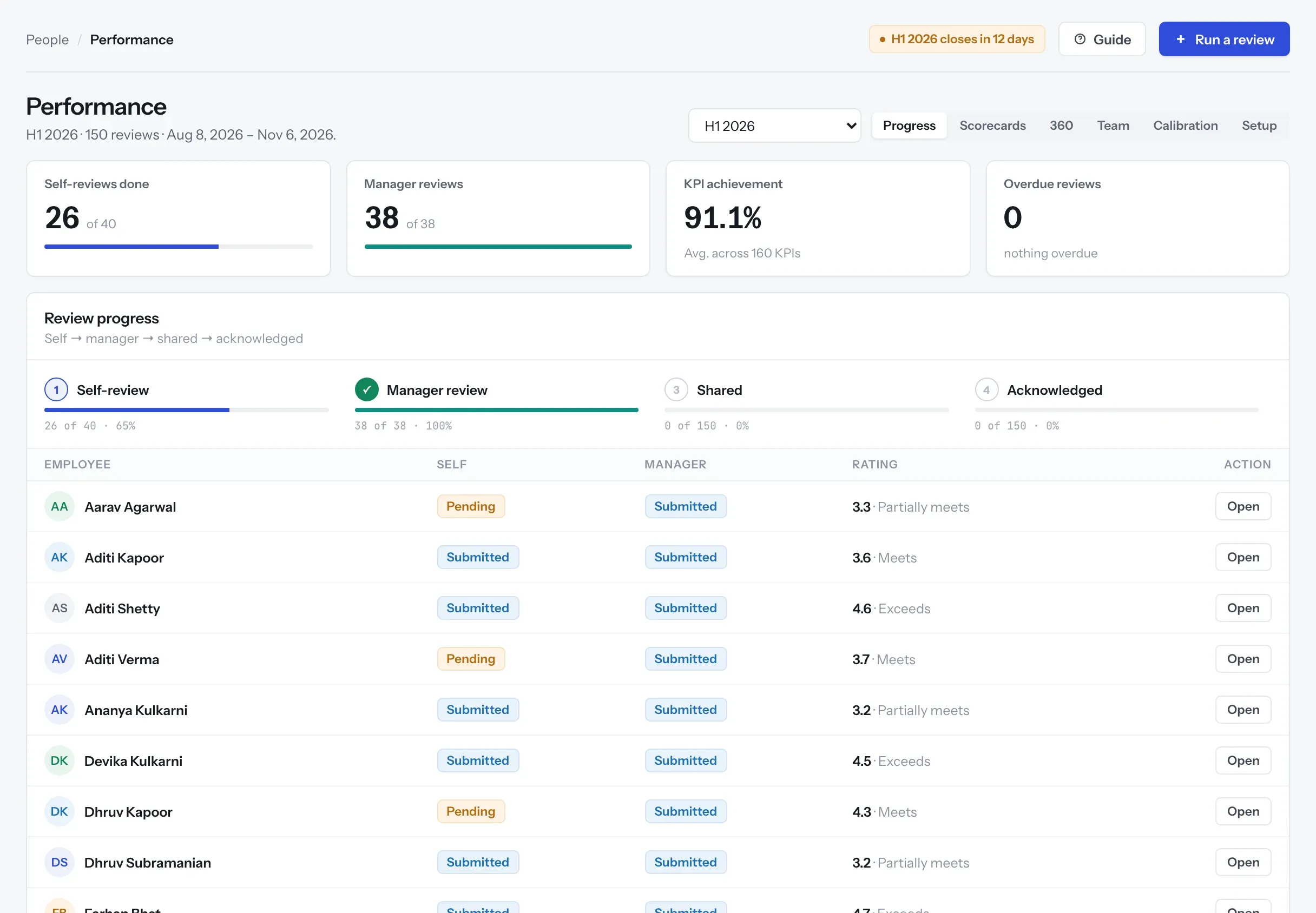
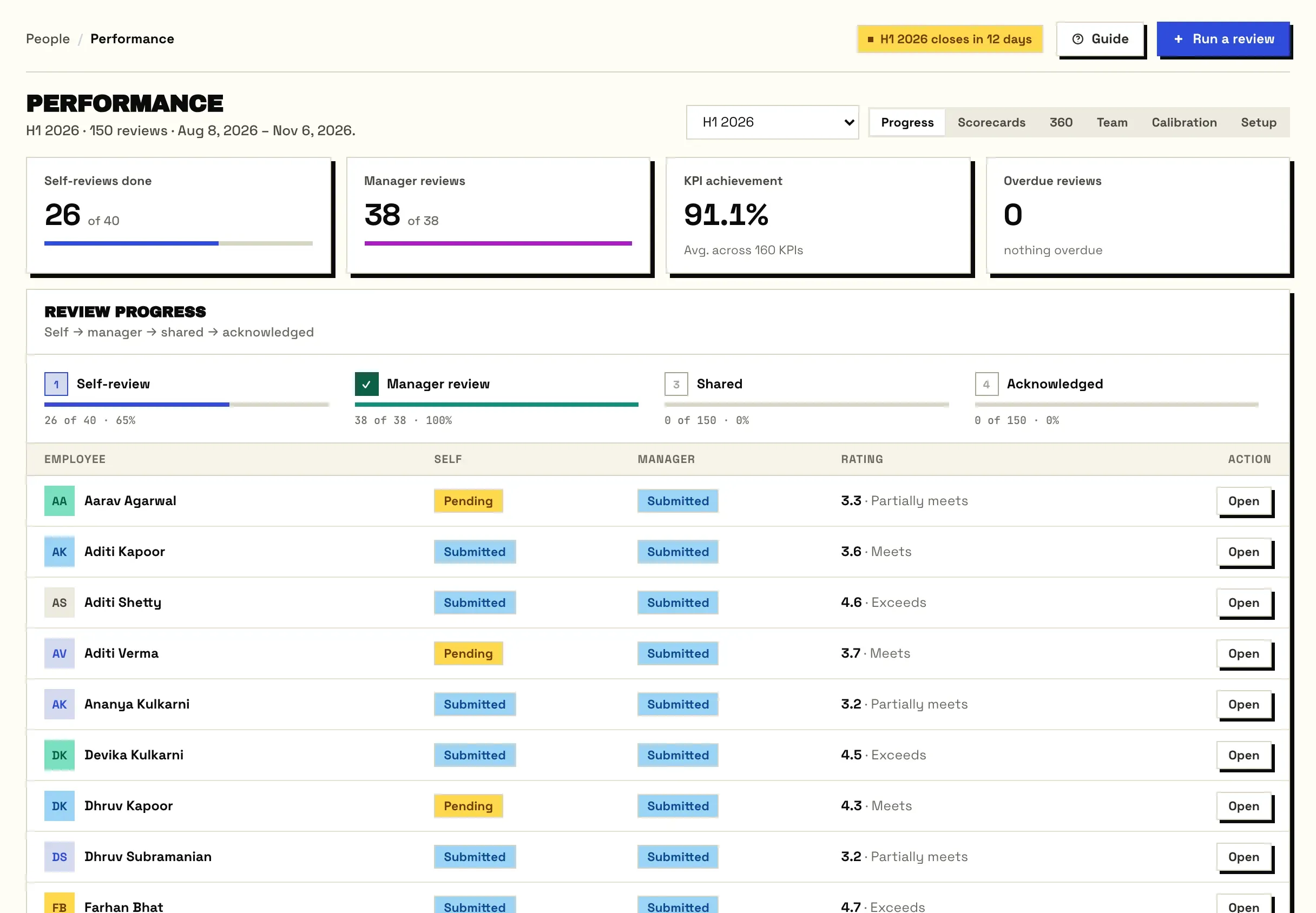
Most of the cost of a review season is administration: who is in it, who writes what, who is late. A cycle knows all of that, so nobody keeps a tracker beside it.
Cycles that launch once
A cycle has a window and a population. Launching it creates a review for every active employee in scope, and launching it again tops up the people who joined since. Nobody gets two.
Ad-hoc reviews
Probation, a project wrap-up, a role change. Raise a review for one person with a due date, outside any cycle, on the same record and the same rules.
Self-appraisal alongside
The employee scores their own KRAs as a review of its own, so the conversation has their account of the period on the record next to the manager's.
Manager review on the same tree
The reviewer scores the subject's own KRA tree on a 1 to 5 scale, area by area. The overall rating sits on the record, not in an attached document.
One guided flow
Run a review walks HR through it in order: what kind of review, the dates, the scorecard, the reviewers, then a confirmation written in plain sentences, because the next click emails a few hundred people.
Read and acknowledge on the phone
A shared review lands in the mobile app. The subject reads it and acknowledges it there. Writing a review stays on the web, where there is room to do it properly.
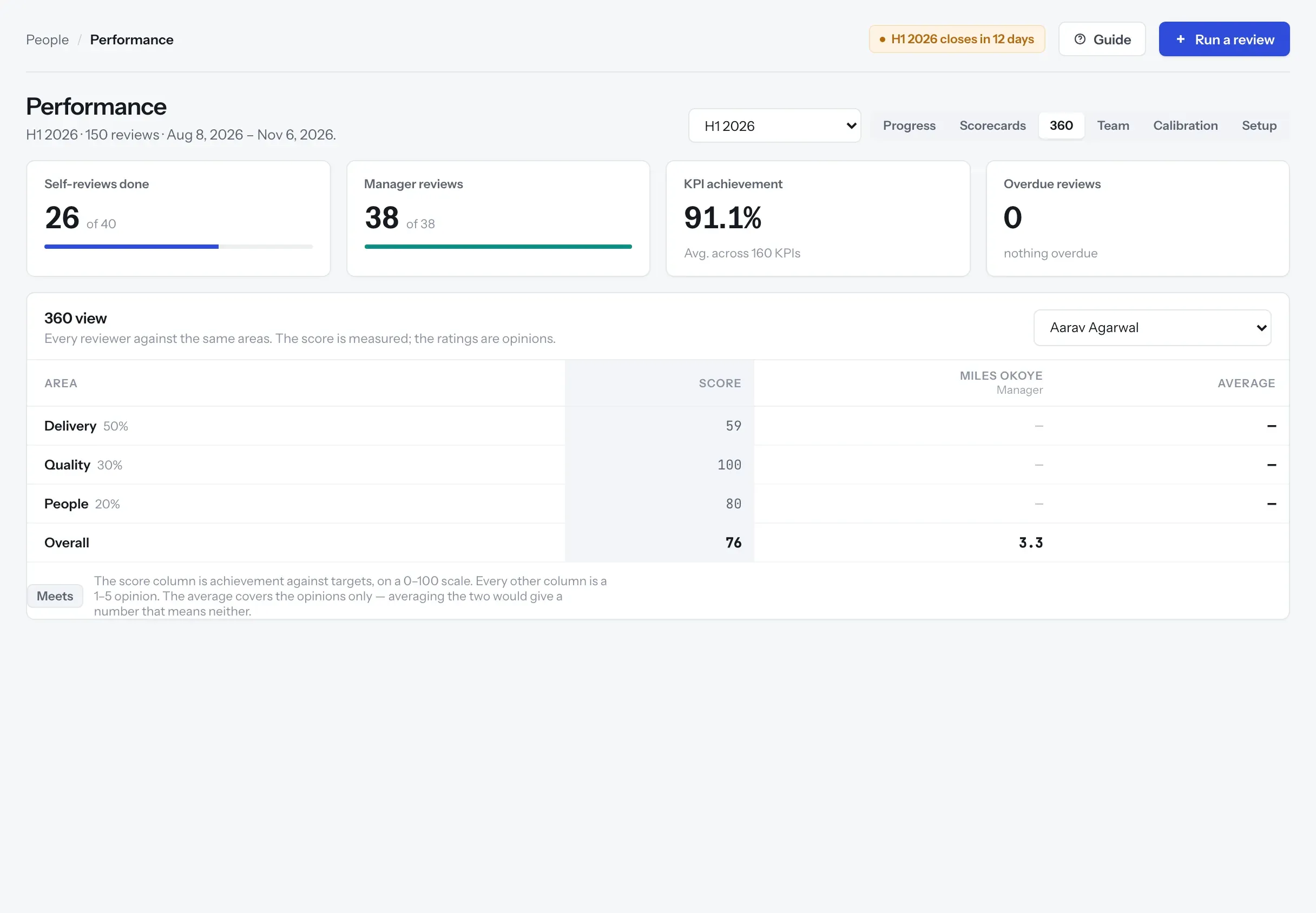
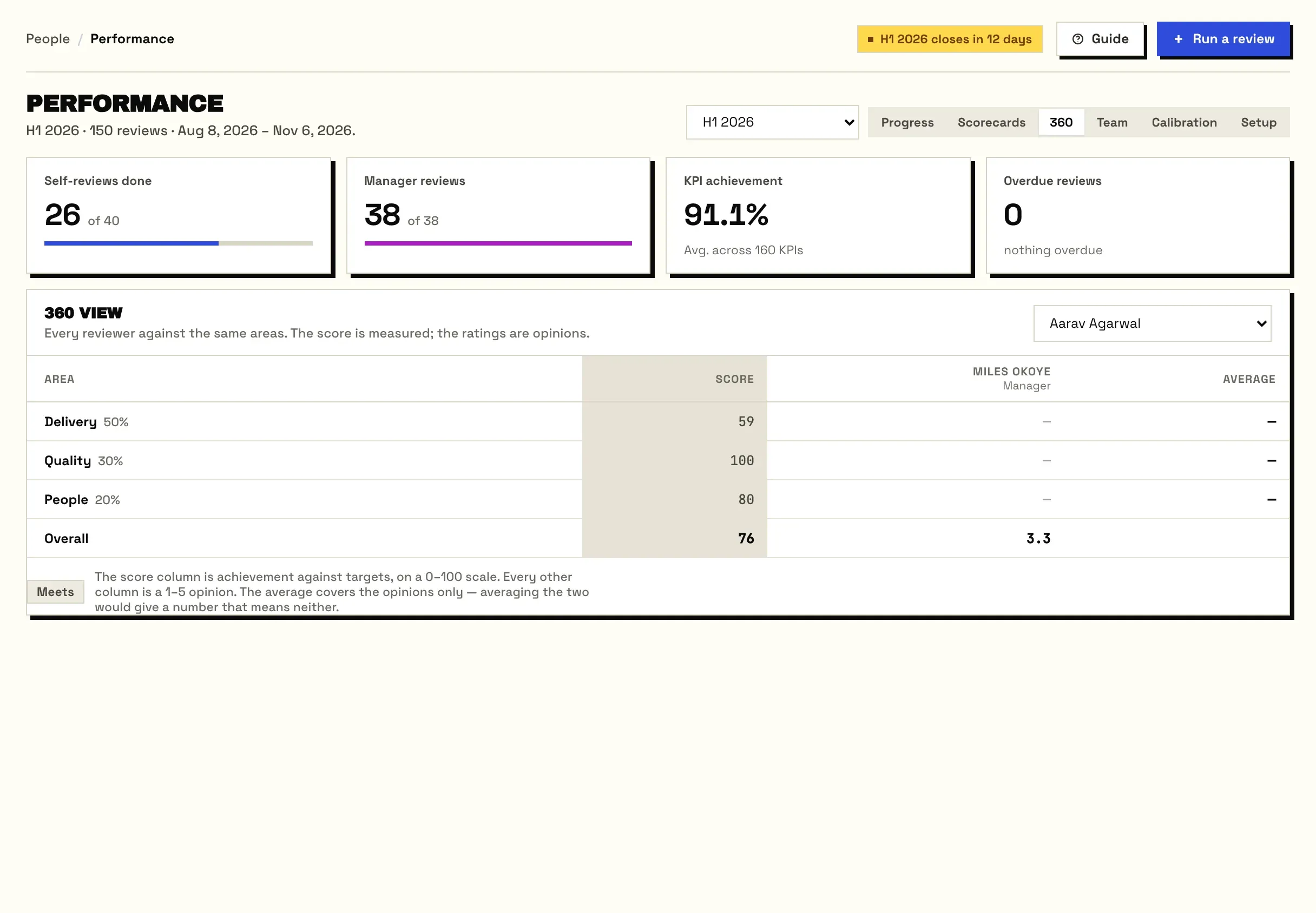
360 · KRA × reviewer
Peers anonymous| Self | Manager | Peer | Peer | Peer | |
|---|---|---|---|---|---|
| Revenue | 4 | 4 | 3 | 4 | 4 |
| Customer | 5 | 4 | 4 | 5 | 4 |
| People | 3 | 3 | 4 | 3 | 3 |
Three peer reviews shared, so the subject can now see peer feedback. With two, they would see none of it.
360 and peer reviews
Anonymous means it cannot be worked out.
A promise of anonymity is the one setting you cannot take back once people have written under it. So it is on by default, and it comes with a floor.
- Nominate, then approveThe subject, their manager or HR nominates up to ten peers. A manager or HR approves the list, and the subject can never approve their own reviewers.
- A floor of threeUntil at least three peer reviews have been shared, the subject receives none of the content, not just none of the names. One or two reviews, read side by side, identify their authors.
- Every view against the same KRAsSelf, manager and peers score the same areas, so the matrix compares like with like rather than three documents.
Calibration
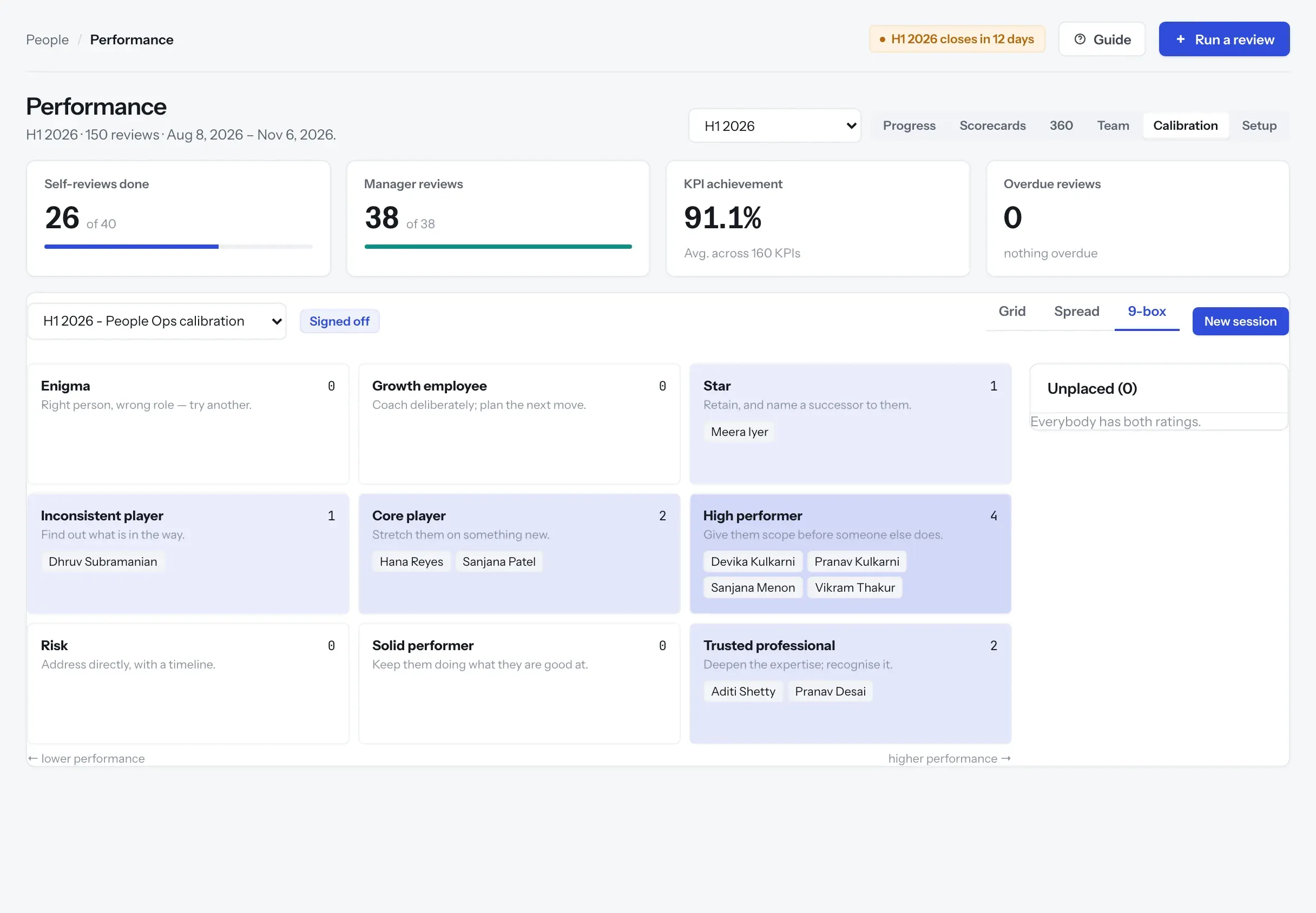
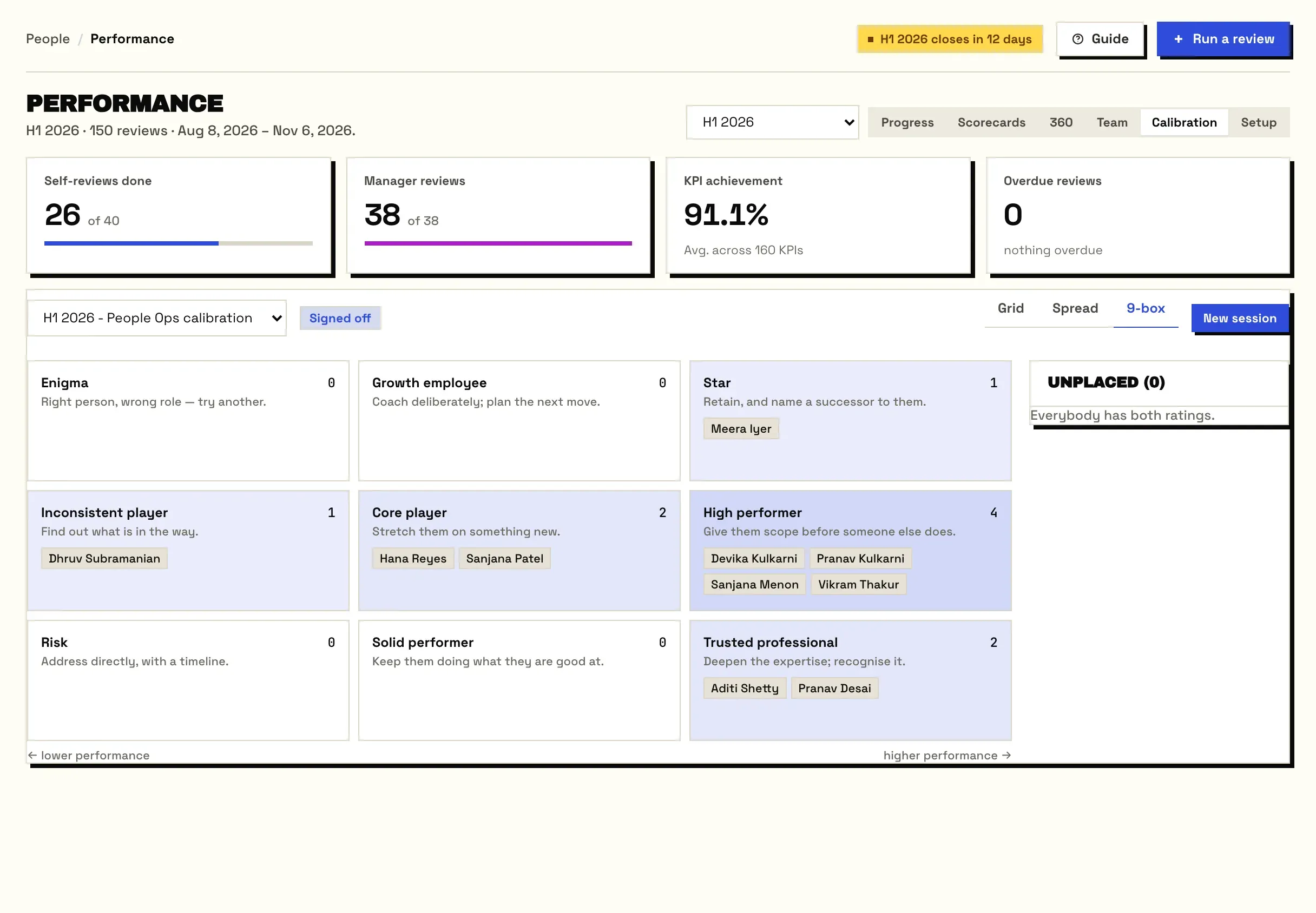
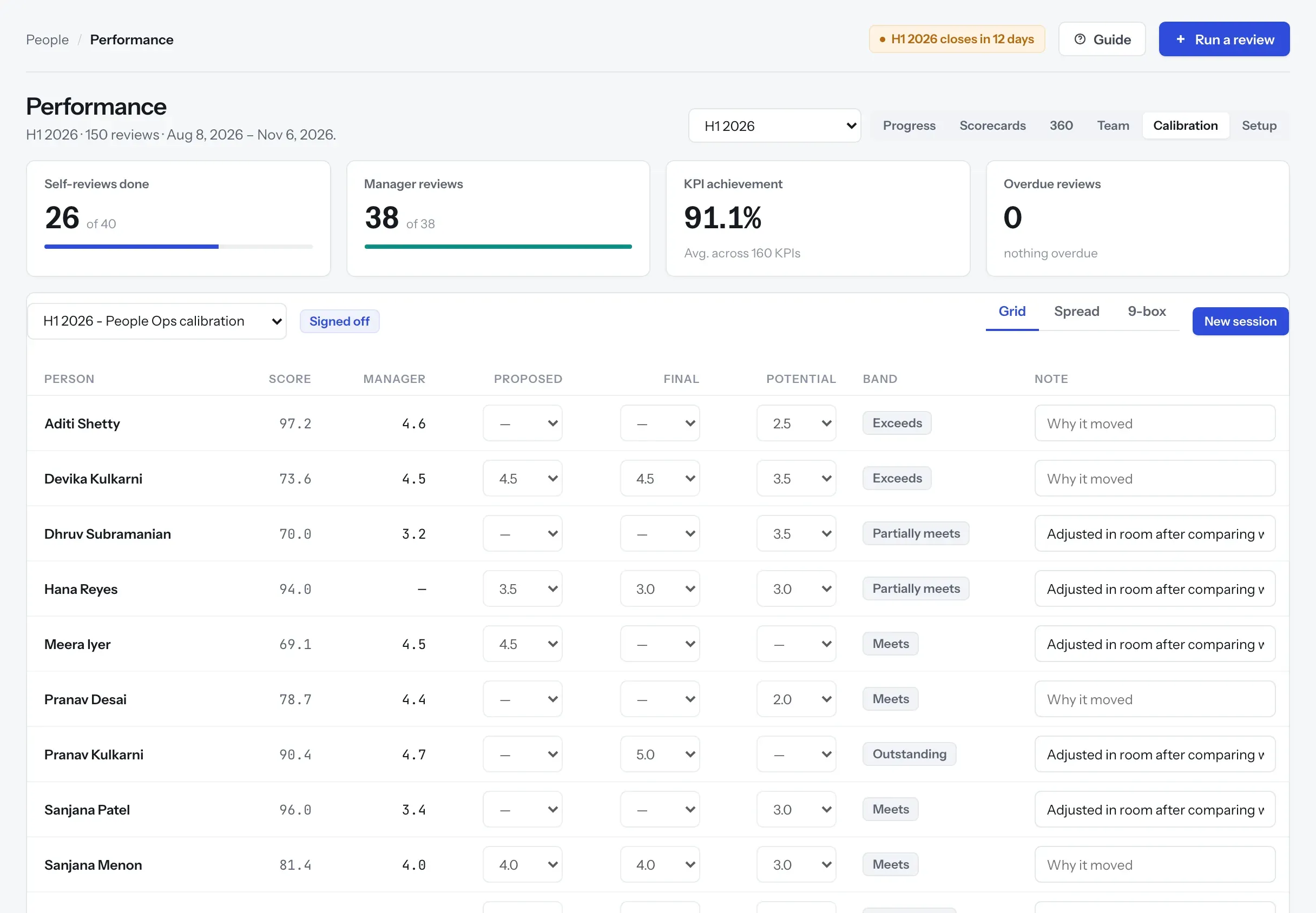
The room moves people on a grid. The grid remembers.
A calibration session snapshots each person's manager rating and scorecard at the moment it opens, so the room argues over one set of numbers. Final ratings are recorded against the snapshot, every adjustment is audited, and once the session is signed off it stops accepting edits.
Nine-box · Engineering · H1
37 on the gridPerformance →
Authorization, said plainly
You cannot move a review onto a colleague by editing it.
Reaching a record tells you which object you may open. It never tells you what you may set on it. Performance is where that distinction stops being academic, because the record decides someone's increment.
- Reviewer and subject are frozen after creationThe two people a review names are fixed when it is created. There is no edit that re-points the document at somebody else.
- Every write is checked on the result, not the draftThe change is authorized as the record would be after saving, not as it was when you loaded it.
- A review moves forward, never backDraft, submitted, shared, acknowledged. Once shared it is history; the subject cannot acknowledge a review that has not been shared with them.
- Ratings are bounded by the scorecardA reviewer scores 1 to 5, and only the KRAs on the subject's own scorecard. A rating for an area that person was never set is refused.
Scores feed incentives
KPI achievement is the figure the incentive engine reads, over-achievement included. Achievement can be imported in bulk from CSV, so nobody updates two hundred sales officers by hand.
Learn moreVisibility follows the org tree
A manager sees their subtree's scorecards because of the reporting line. Move an employee and the visibility moves with them.
Learn moreIt reaches people in Slack
Every in-app notification, a review shared with you included, can arrive as a Slack message once your account is linked.
Learn moreIn the product
The cycle, the scorecard and the room.
Book a demo · 30 min
Bring us your review cycle.
We will build your scorecard template, run a 360 with the anonymity floor, and move people across a nine-box on your own org chart.