Policies that accrue
and approve themselves.
Accrual, carry-forward, encashment and a holiday calendar per location, running on the same approval engine as expenses and onboarding. Balances are live, which is what actually stops the question.
Why leave is annoying
Three small errors, repeated every month.
Leave looks like the simplest module in an HR system, and it is the one most often run out of a spreadsheet next to the software. The reasons are always the same three.
The accrual is manual
Someone credits the month on the first, in a sheet. The number an employee sees is a copy of a copy, and it disagrees with payroll by the third quarter.
One policy for every type
Sick leave and earned leave do not behave alike. A tool that models one set of rules and applies it to all seven types gets worked around within a month.
One holiday calendar
A Chennai holiday is not a Gurugram holiday. Count working days off the wrong list and the deduction is wrong, quietly, for everyone at that location.
How a policy is defined
Write the rule once. It runs itself after that.
A leave policy in ZivoHR is a record, not a convention. Accrual schedule, cap, lapse date and eligibility are fields the system evaluates, so the balance an employee sees on the fourteenth is the balance the rule produces.
Accrual on a schedule
Monthly or annual, credited on a date you choose, pro-rated for anyone who joined part-way through the period. Nobody runs it by hand.
A type per behaviour
Earned, casual, sick, maternity, paternity, comp-off and unpaid each carry their own rules: accrual rate, cap, documentation threshold, whether the balance may go negative.
Holiday calendars per location
Each location has its own list. The working-day count comes off the employee's calendar, so the same five dates deduct differently in Chennai and in Gurugram.
Approvals on the shared engine
Request, approver, decision, action, notification. Multi-level chains where a long absence needs a second signature, and delegation when the approver is themselves away.
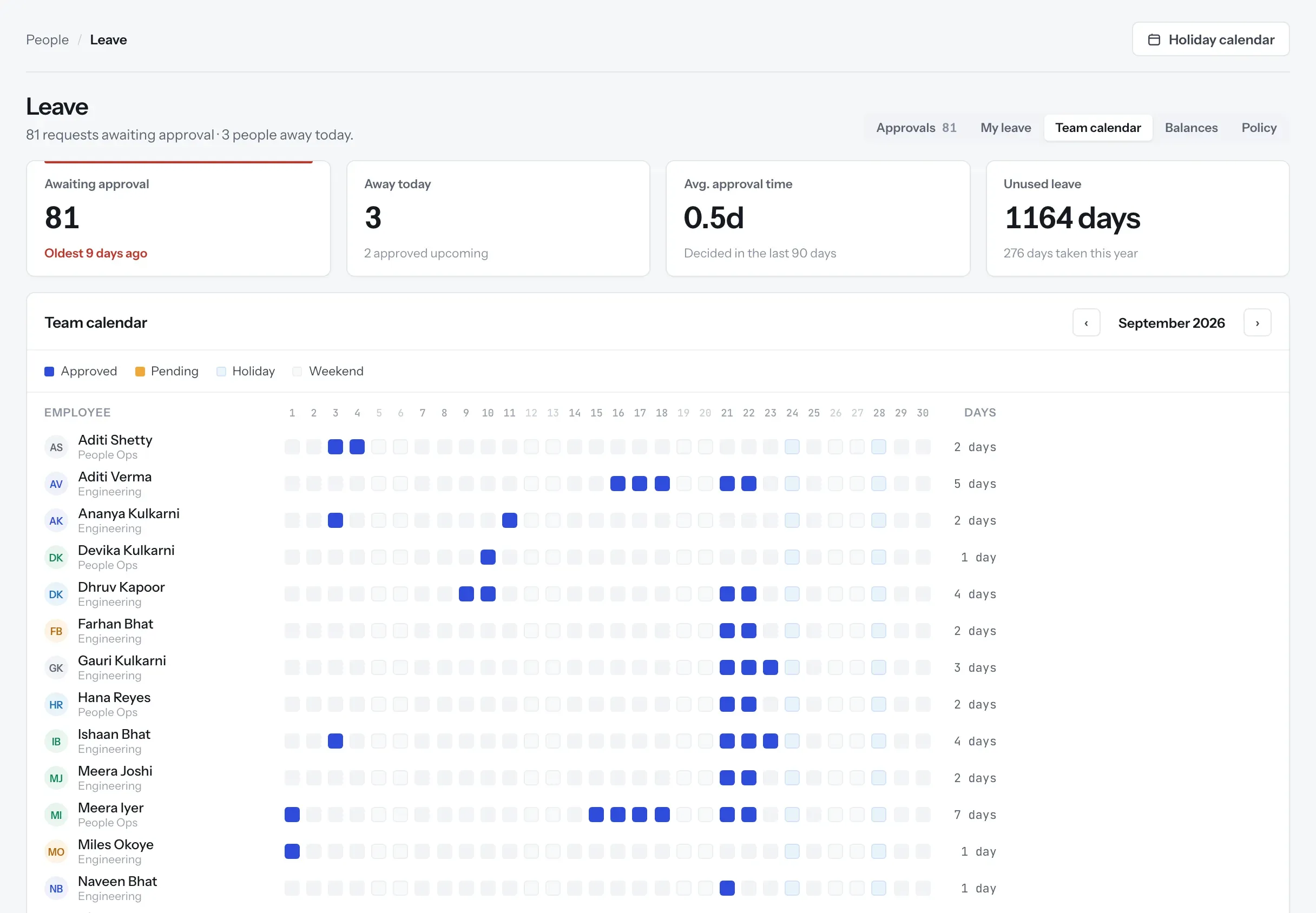
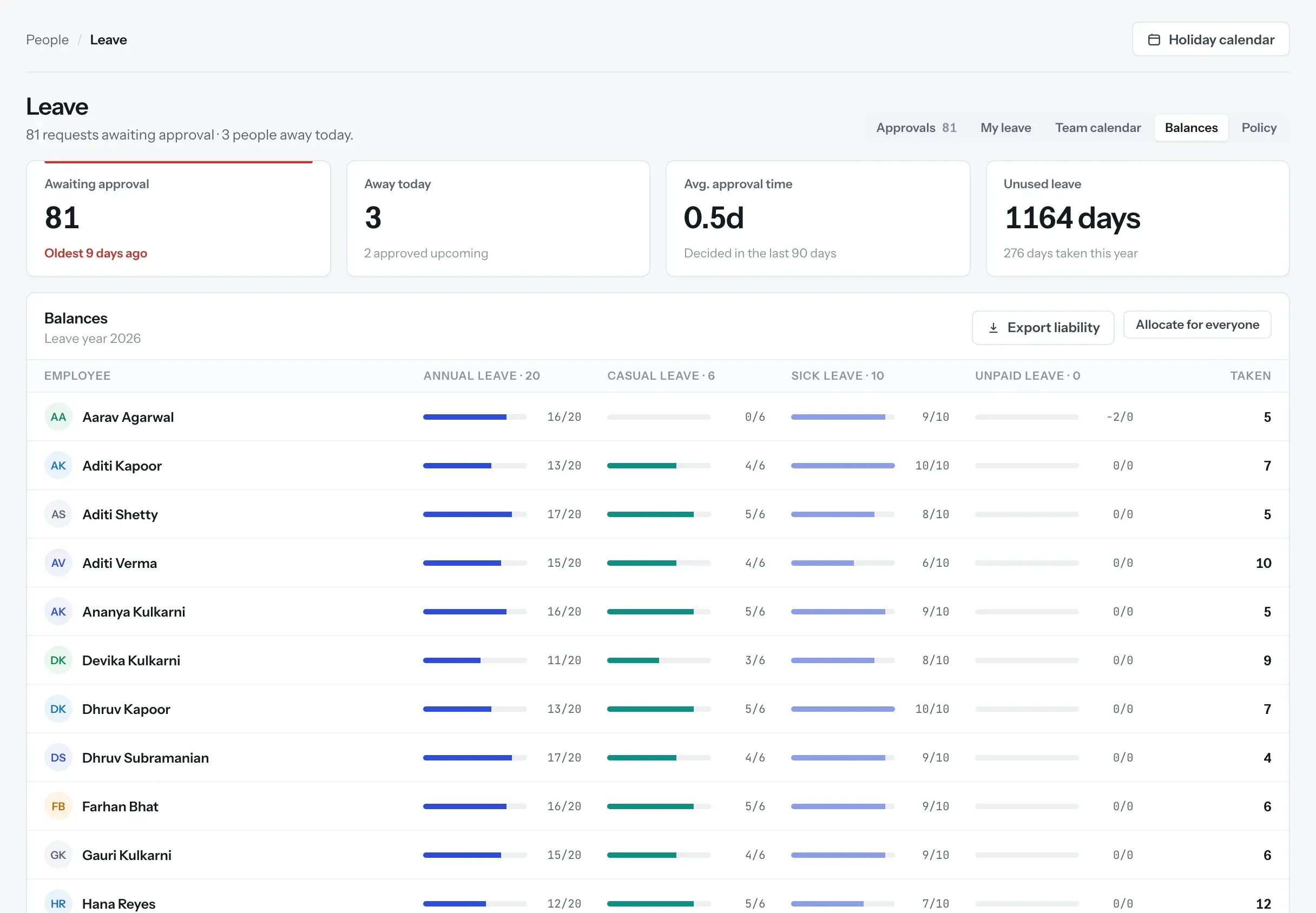
Balances the employee can see
Accrued, consumed, pending approval, available, and the date the remainder lapses. On the web, in the mobile app, and in Ziva.
Half-days and month boundaries
A half-day deducts half a day. Leave running from 29 March to 2 April splits across two payroll periods, and each period is paid on its own attendance.
Carry-forward, lapse, encashment
Year-end is where leave policies break.
Carry-forward is capped. Whatever exceeds the cap lapses on a date. Whatever is encashable becomes a component in the next payroll run. All three are the same policy record, so what an employee reads in December is what payroll pays in January.
My balances · 1 September 2026
14–18 October falls across one location holiday, so the request deducts four days.
Ziva · the AI layer
“Can I take the 14th to the 18th?”
Ziva answers that with the asker's real balance, the holiday calendar for their location and the policy their leave type actually carries — then offers to file it and route it to the right approver. It queries through the asker's own permissions, so a manager and an intern get correctly different answers.
- Reads the real balanceNot a generic answer about leave policy — the number on the record, as of today in the workspace's timezone.
- Knows the working daysHolidays and weekends for that employee's location are already subtracted before Ziva quotes a figure.
- Files it, then stopsIt drafts and submits the request. The approval itself is a human decision and stays one.
What leave touches
A day off is never only a day off.
Leave is the module with the most edges. Every one of them is a real reference on one record, not an export someone reconciles on the last working day of the month.
Attendance
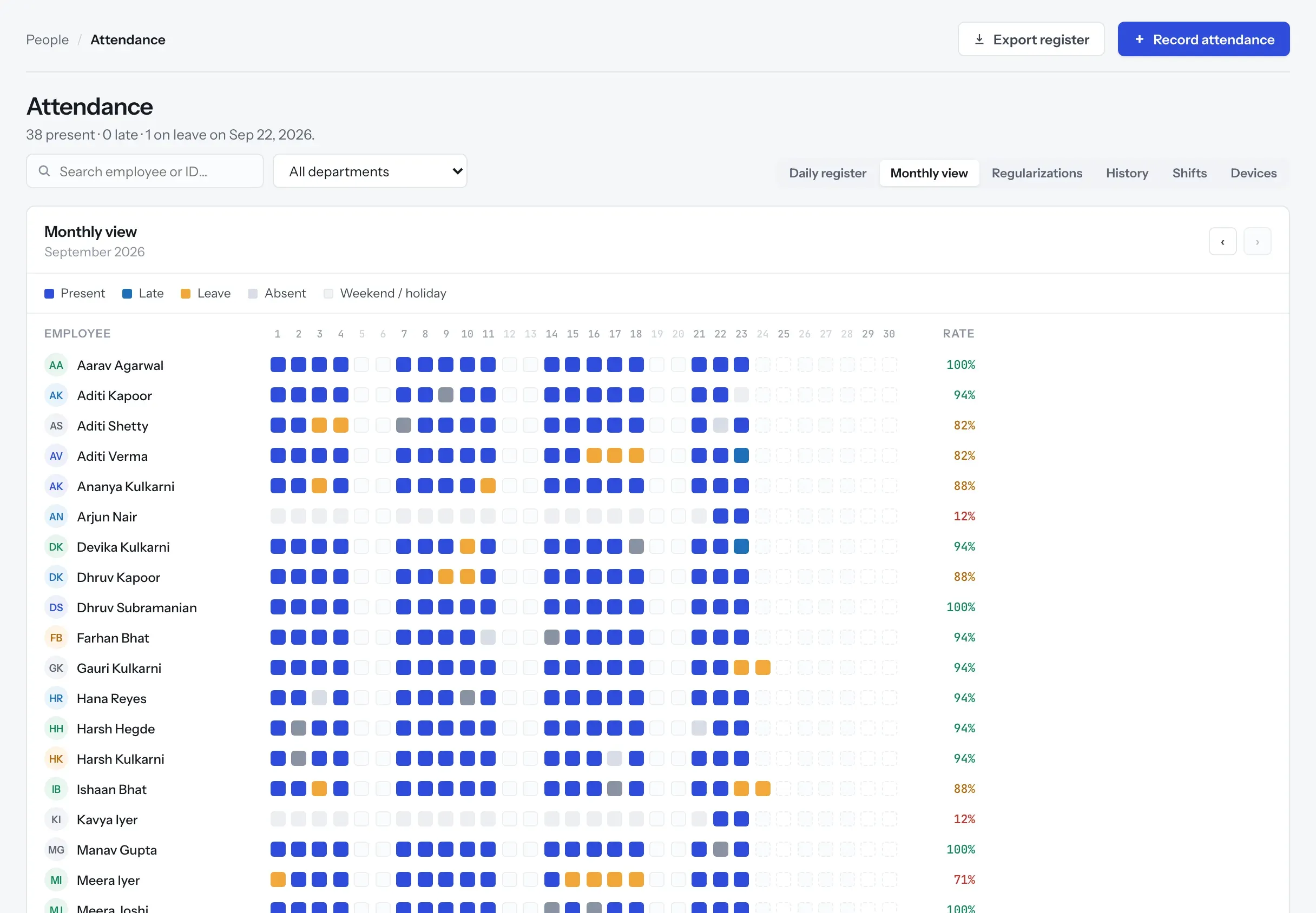
Approved leave lands on the same timeline as punches, so loss of pay is derived rather than guessed.
Learn morePayroll
Unpaid days and encashment become components in the run, in the period the dates actually fall in.
Learn morePeople & org
The approver chain comes from the reporting tree. Change a manager and the next request routes correctly.
Learn moreMobile & Slack
Apply and cancel from the app; the approver hears about it in Slack. The same request, the same audit entry.
Learn moreIn the product
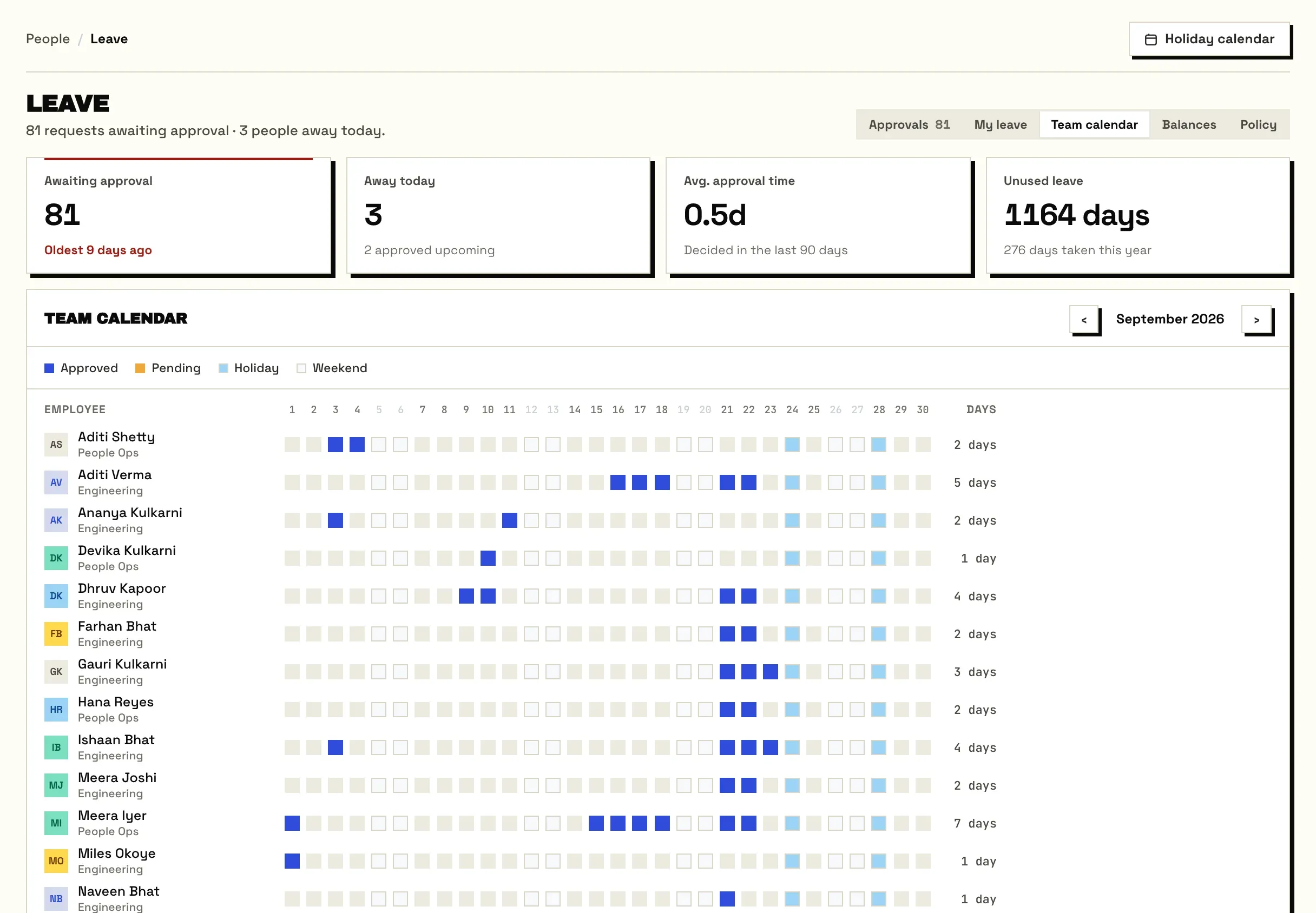
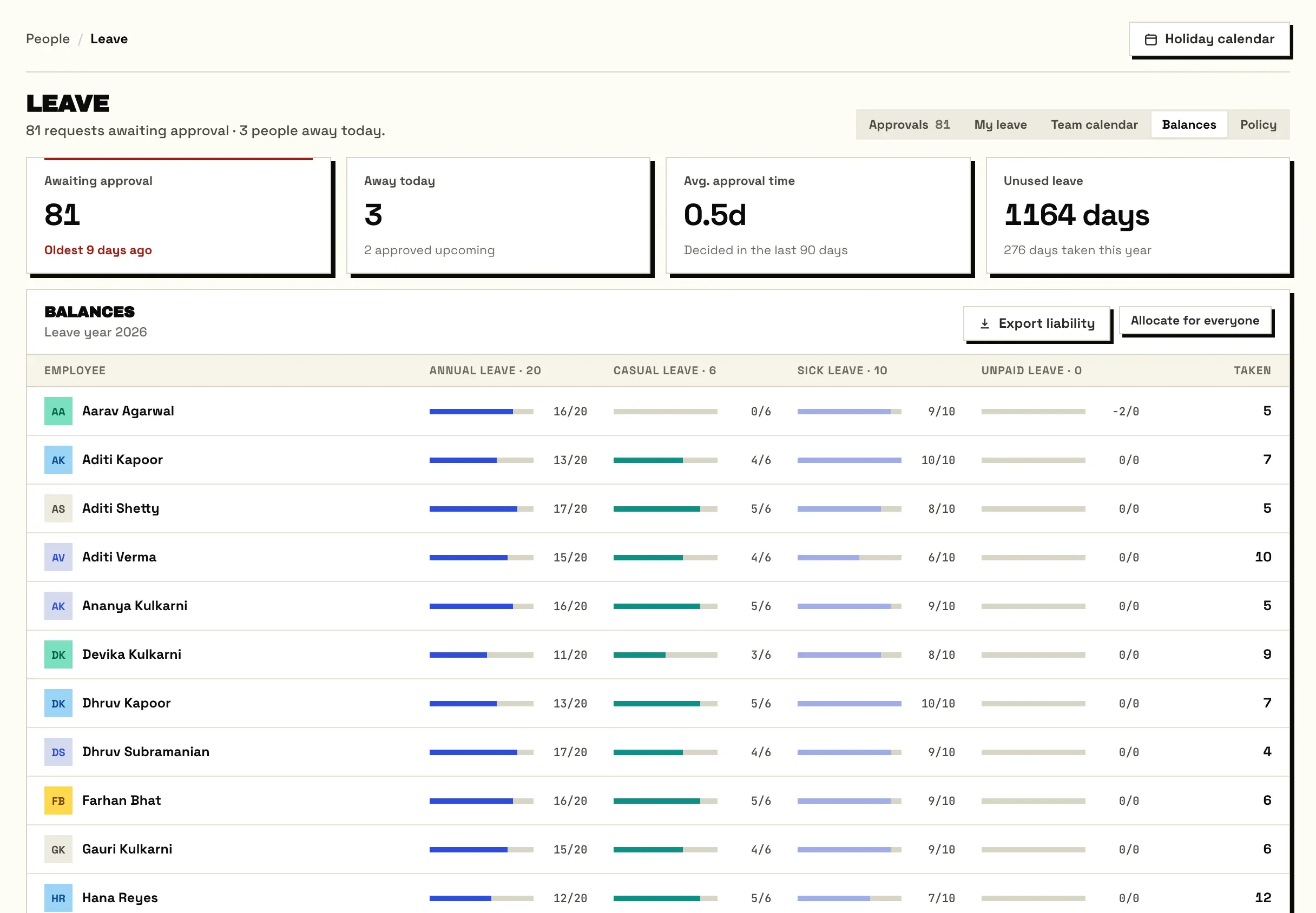
Who is away, and what is left.
Sandwich penalty
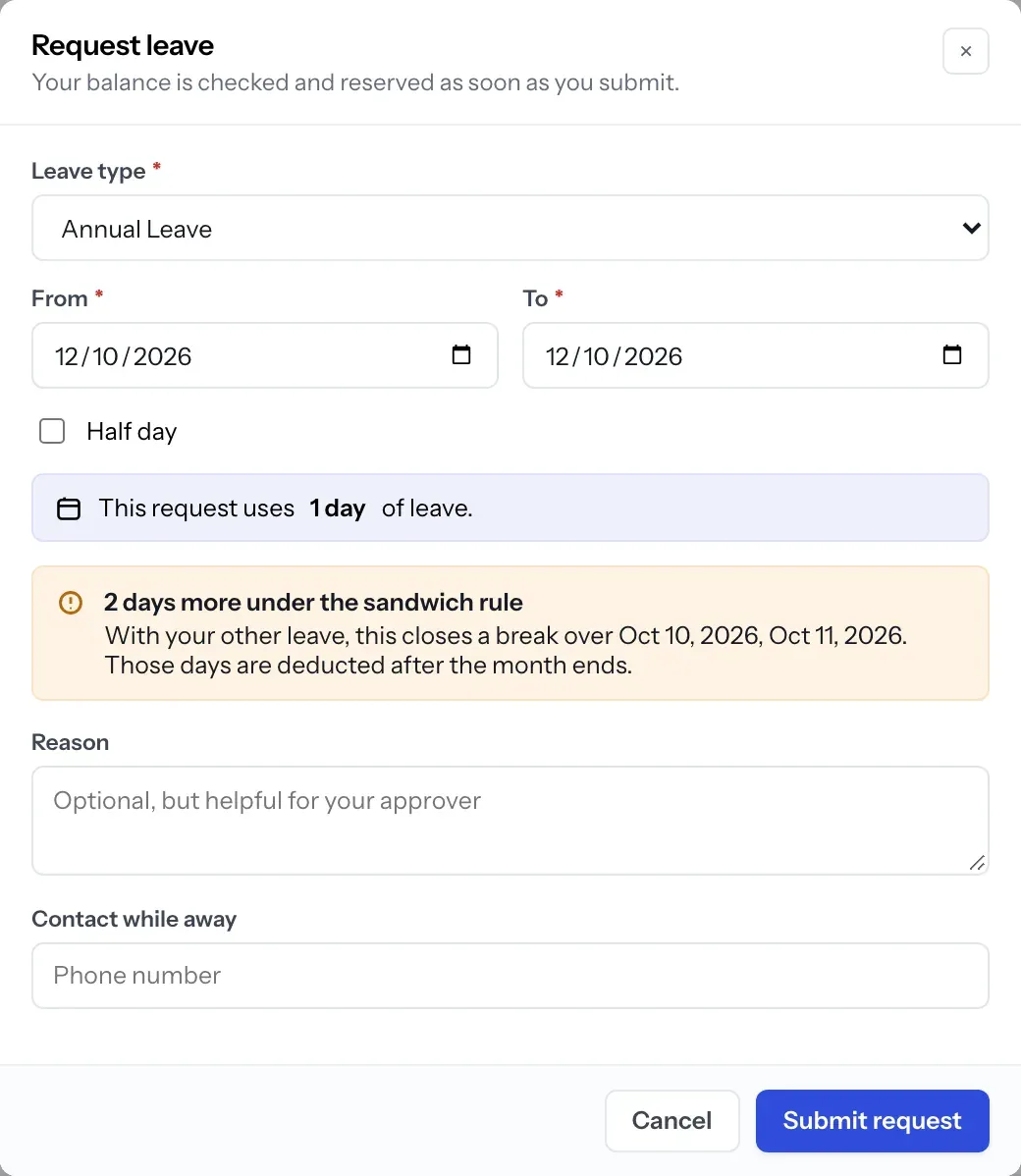
Friday and Monday off, as two requests, still costs the weekend.
The rule reads the calendar an employee is actually asking for, not the shape of the request that got it there.
Across separate requests, not one
File Friday on its own and Monday days later, and the rule still sees one sandwich around the weekend in between.
Which days count is per type
Casual leave can pull in weekends and holidays; earned leave might count weekly offs only; sick leave, holidays only.
When it fires is a policy choice
A policy can trigger on leave on both sides of the gap, or on either side alone — set once per leave type.
What it costs is a policy choice too
The days in between can come off the leave taken, off a separate penalty balance, or land as loss of pay.
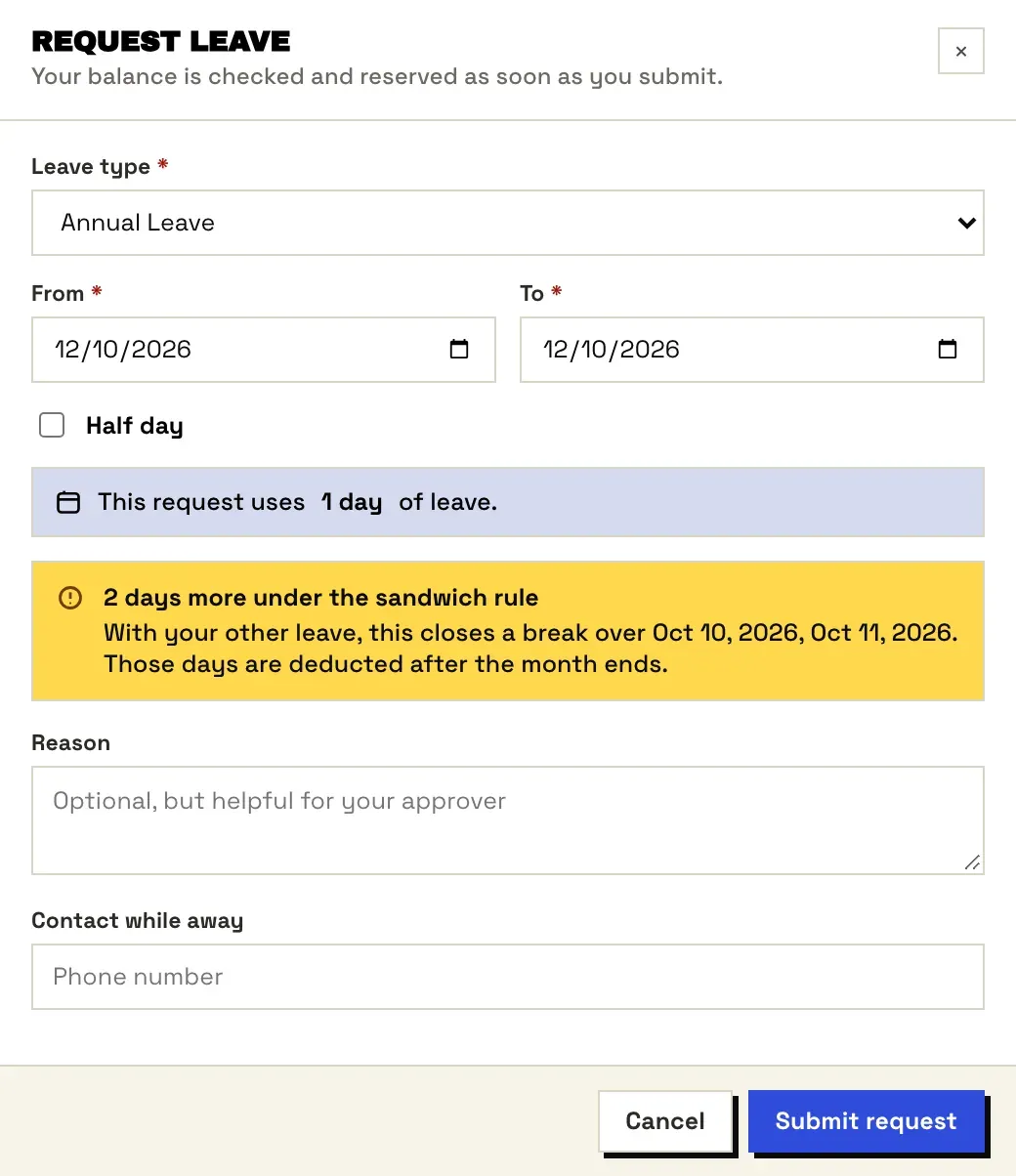
A warning before the submit button
The employee sees the extra days a sandwich adds before they apply, not after approval.
Runs without the attendance module
The calendar, the leave type and the policy are enough. A workspace that has not switched on attendance still gets it right.
Book a demo · 30 min
Bring us the policy nobody wants to explain.
Thirty minutes. Send the carry-forward cap, the comp-off expiry and the location calendars, and we will configure your leave policy while you watch.