Requisition to offer,
one pipeline.
Openings, candidates, stages, interviews and offers on the same system of record as everything after the hire. Mark the candidate hired and the employee record and the onboarding process are created from what the pipeline already holds.
Where hiring leaks
The pipeline is usually three tools and a group chat.
Hiring is the process most likely to be stitched together, because each stage has a tool that does that stage well. The cost is not the tools. It is the three handoffs between them.
Nothing reconciles
A sheet for requisitions, an inbox for CVs, a calendar for interviews. Ask how many candidates are at final round for the Pune role and someone has to go and count.
The hire gets typed twice
Name, email and phone are re-keyed out of the ATS and into HR. The typo surfaces at the first payroll run, on a payslip, in front of a new joiner.
Decisions have no evidence
Feedback lives in chat threads. Six months later nobody can explain why a candidate was rejected, and the panel that disagreed is invisible.
One pipeline, no re-entry
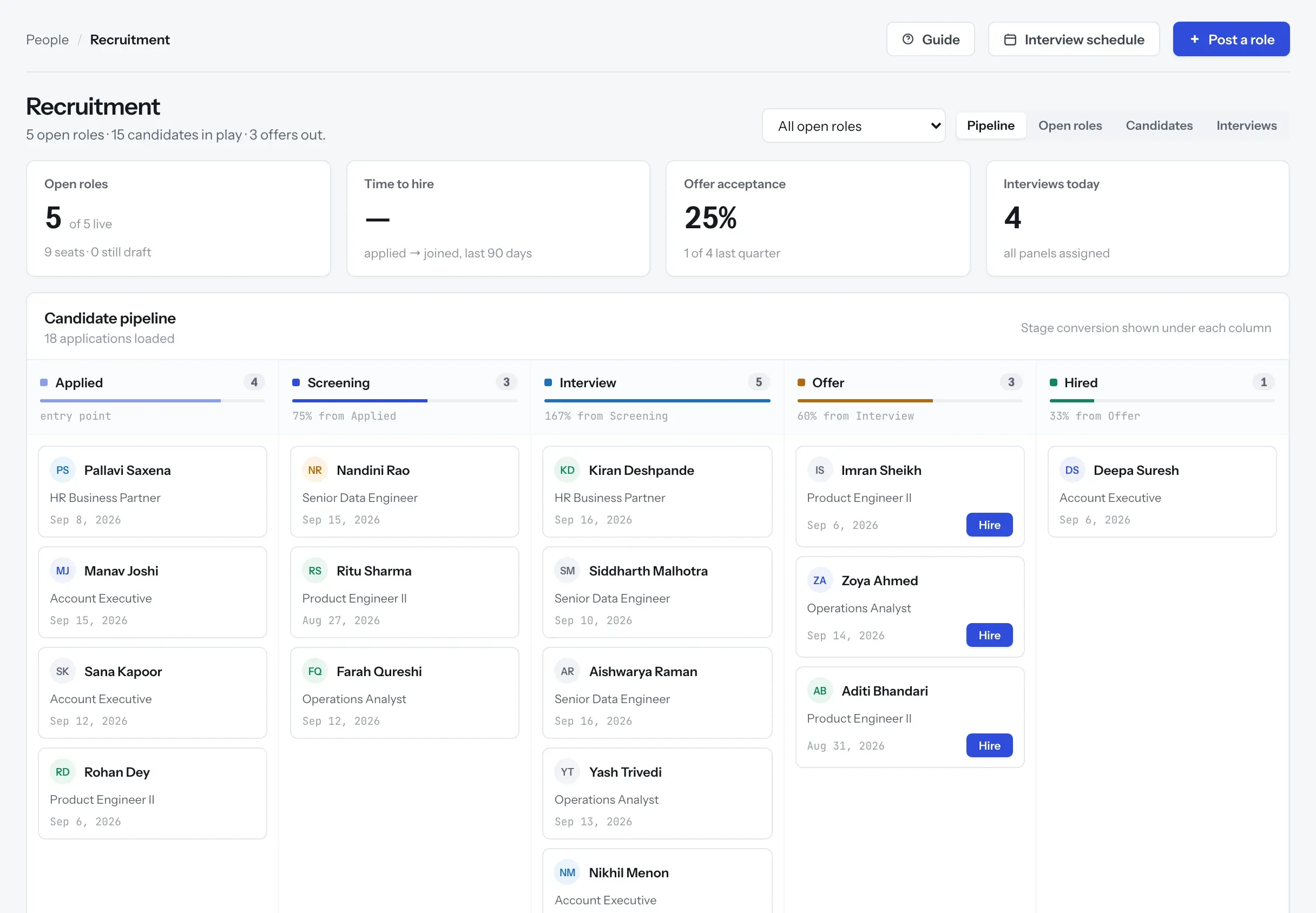
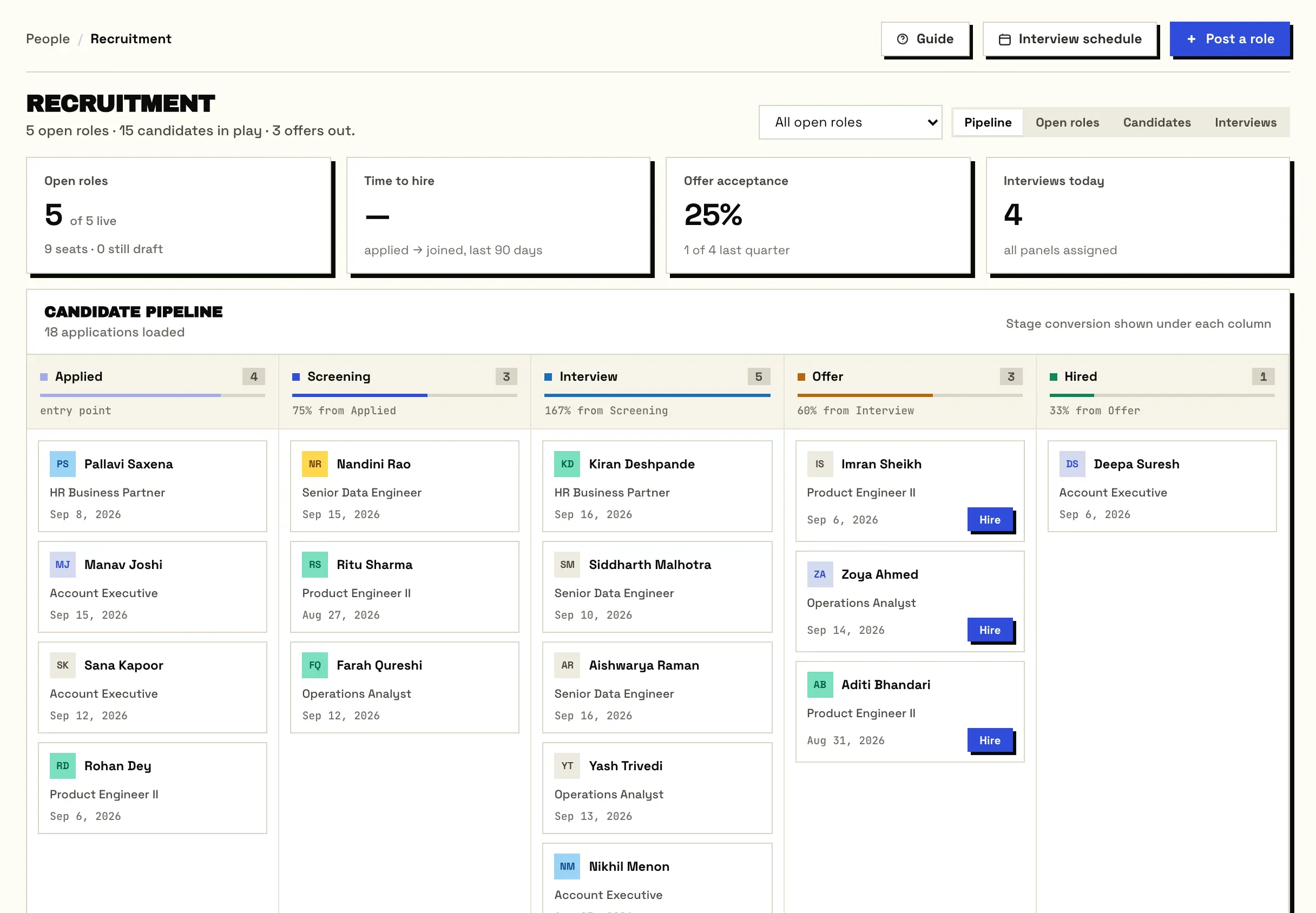
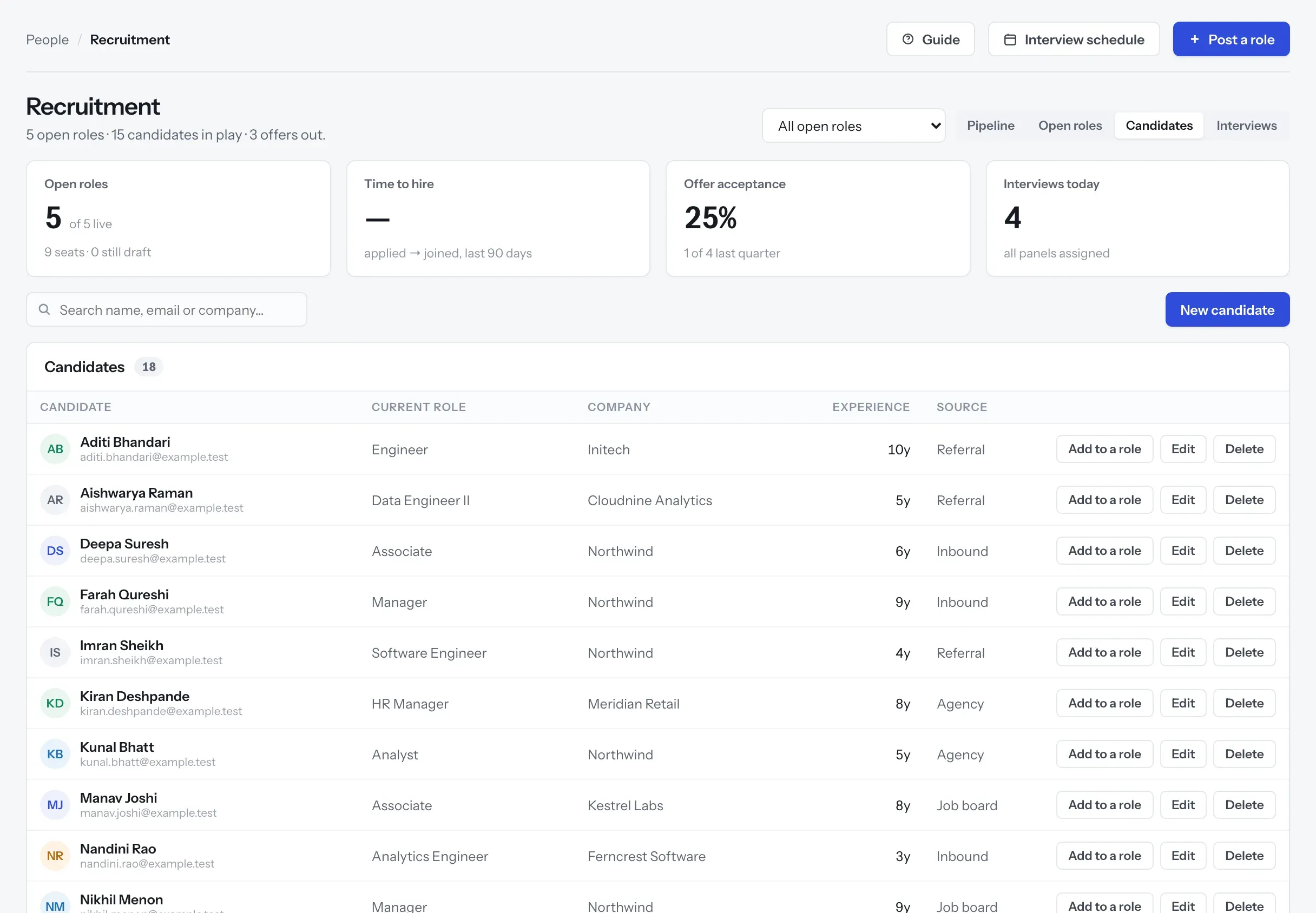
Opening, candidate, application, interview, offer.
Five objects with real relations between them. A candidate advances by moving to the next stage on the same record — never by being copied into a second system so that the next step can begin.
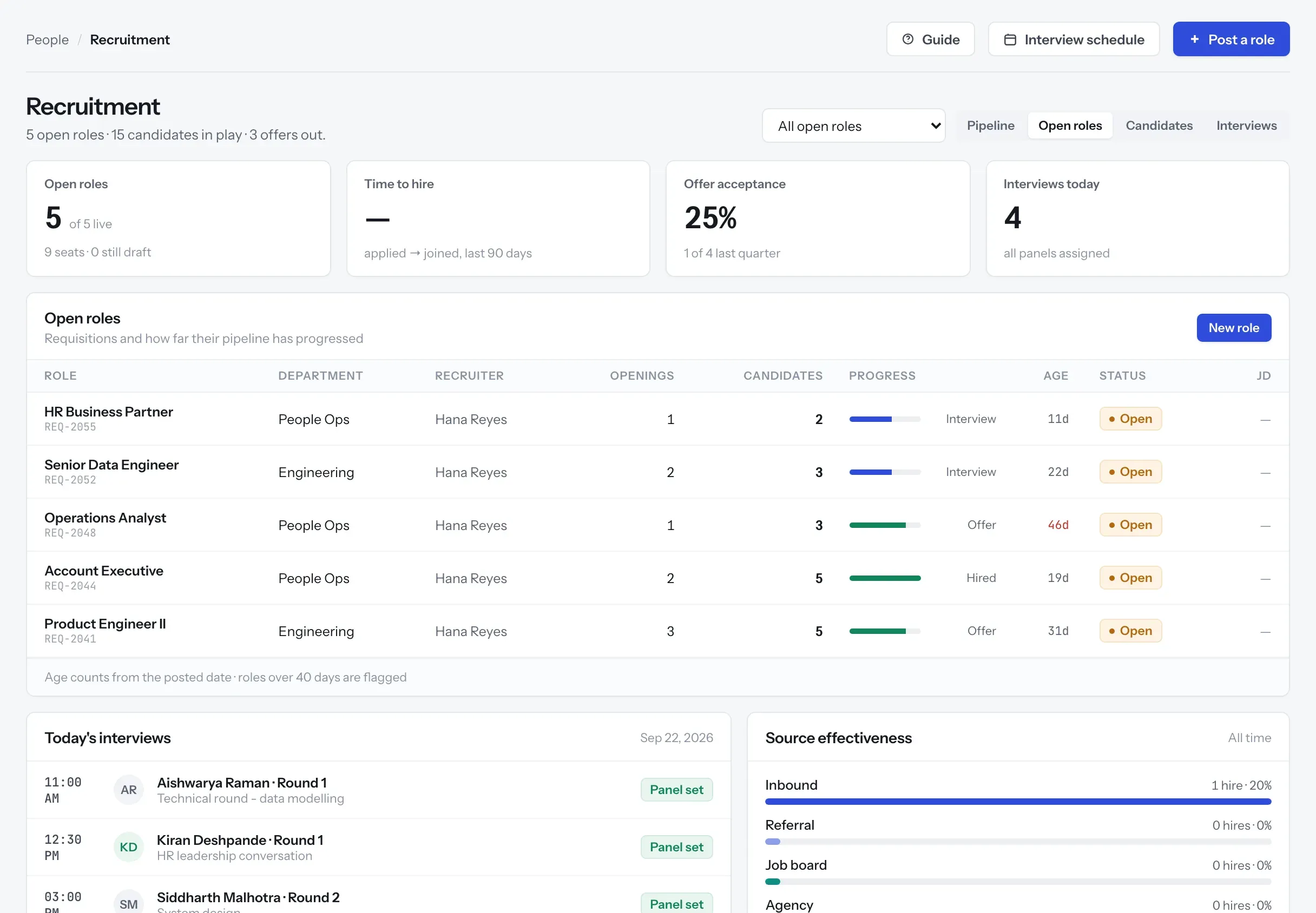
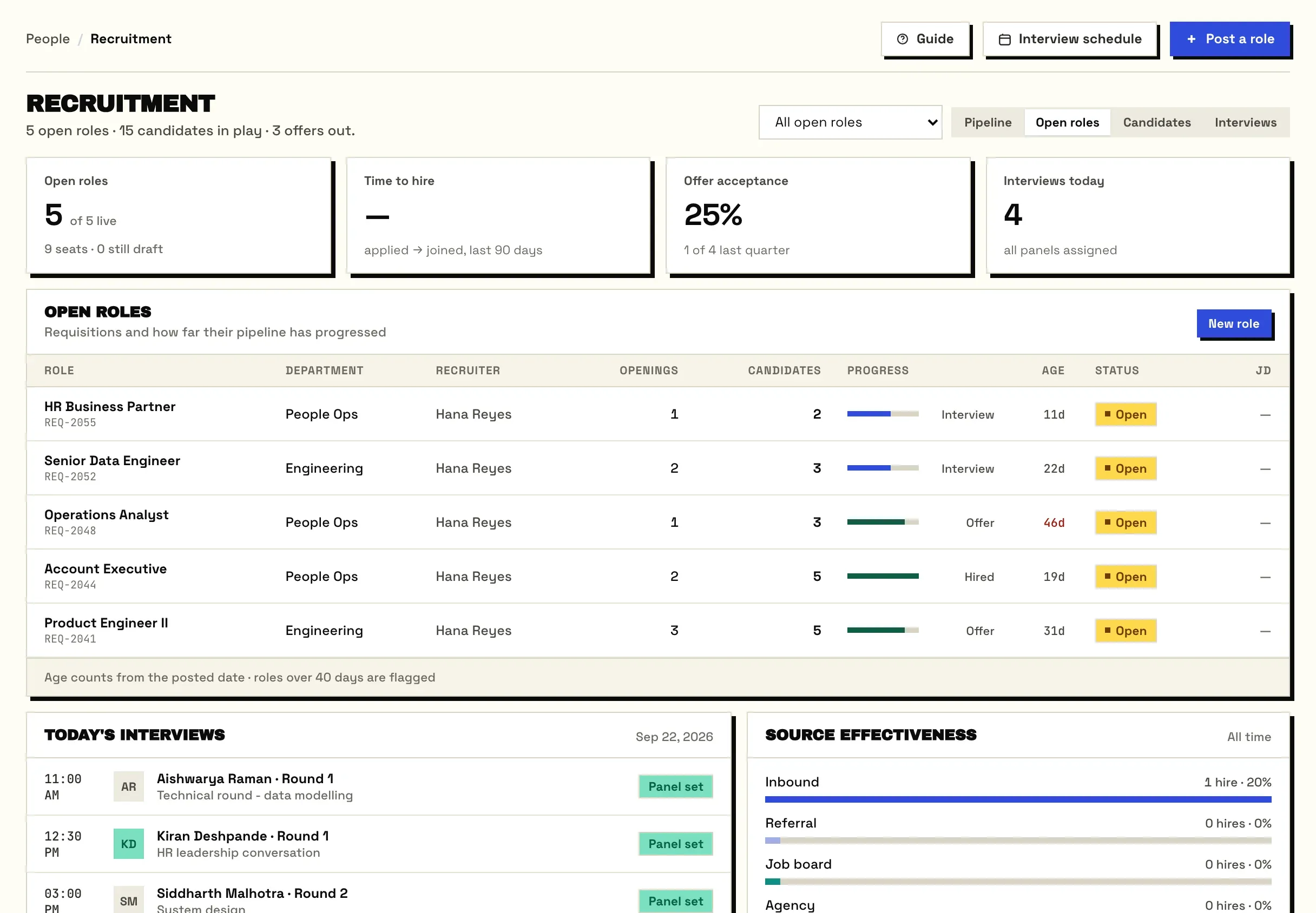
An opening with its shape
Department, designation, location, hiring manager, recruiter, headcount, salary band and the job description as a file. Candidates apply against a real place in the org tree.
Candidates on stages, not in folders
Applied, screening, interview, offer, hired, rejected, withdrawn. Every move is recorded with who made it and a note, and the pipeline count is a query, so it is right when you look.
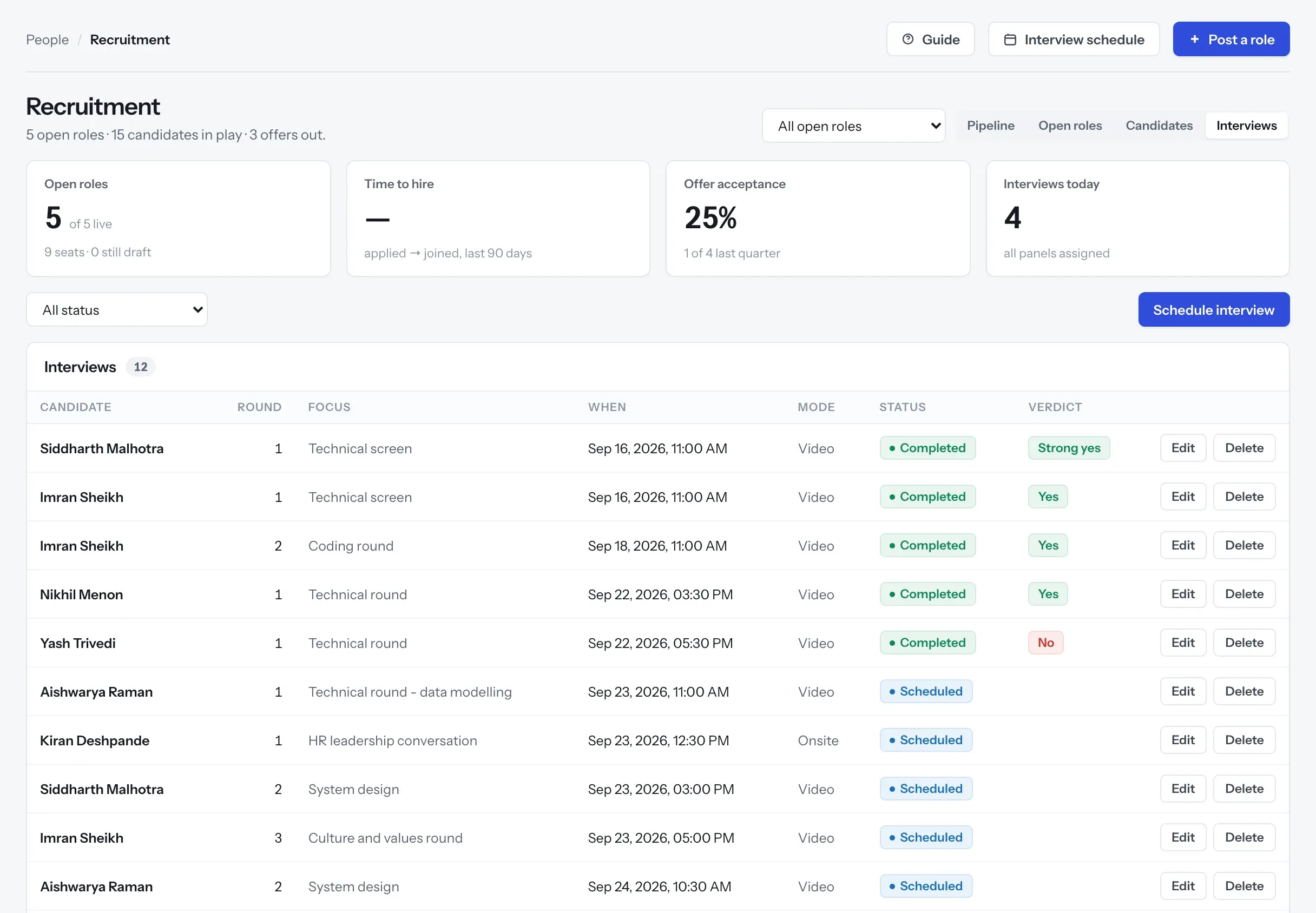
Interview rounds
Numbered rounds with a panel, a mode and a slot. The candidate gets an email with the date, time, format and where to be, in the workspace's own timezone.
Feedback on the round
Each round records written feedback, a rating out of five and a recommendation from strong yes to strong no. The decision has evidence, and a dissenting panellist is on the record.
The hire becomes the employee
One action converts the application into an employee record and starts onboarding. The offered salary and the dates the offer went out and was accepted stay on the application.
Scoped, and visible by role
Candidate data is tenant-scoped like every other row: a recruiter at one workspace cannot reach another's pipeline at all. A candidate can be converted once, and a second attempt is refused.
The handoff
The join between hiring and HR is where most stacks stop.
The hire is the point where two systems normally become one spreadsheet. Here it is one action on a record that already holds the candidate, so the transition costs nobody an afternoon. Before day one, the joiner gets a link to upload their paperwork without needing an account.
Candidate hired
14 Sep 2026- 1Employee record createdName, email and phone carried from the candidate; location, department and designation set on the hire
- 2Reporting line setManager assigned, so subtree visibility is correct before day one
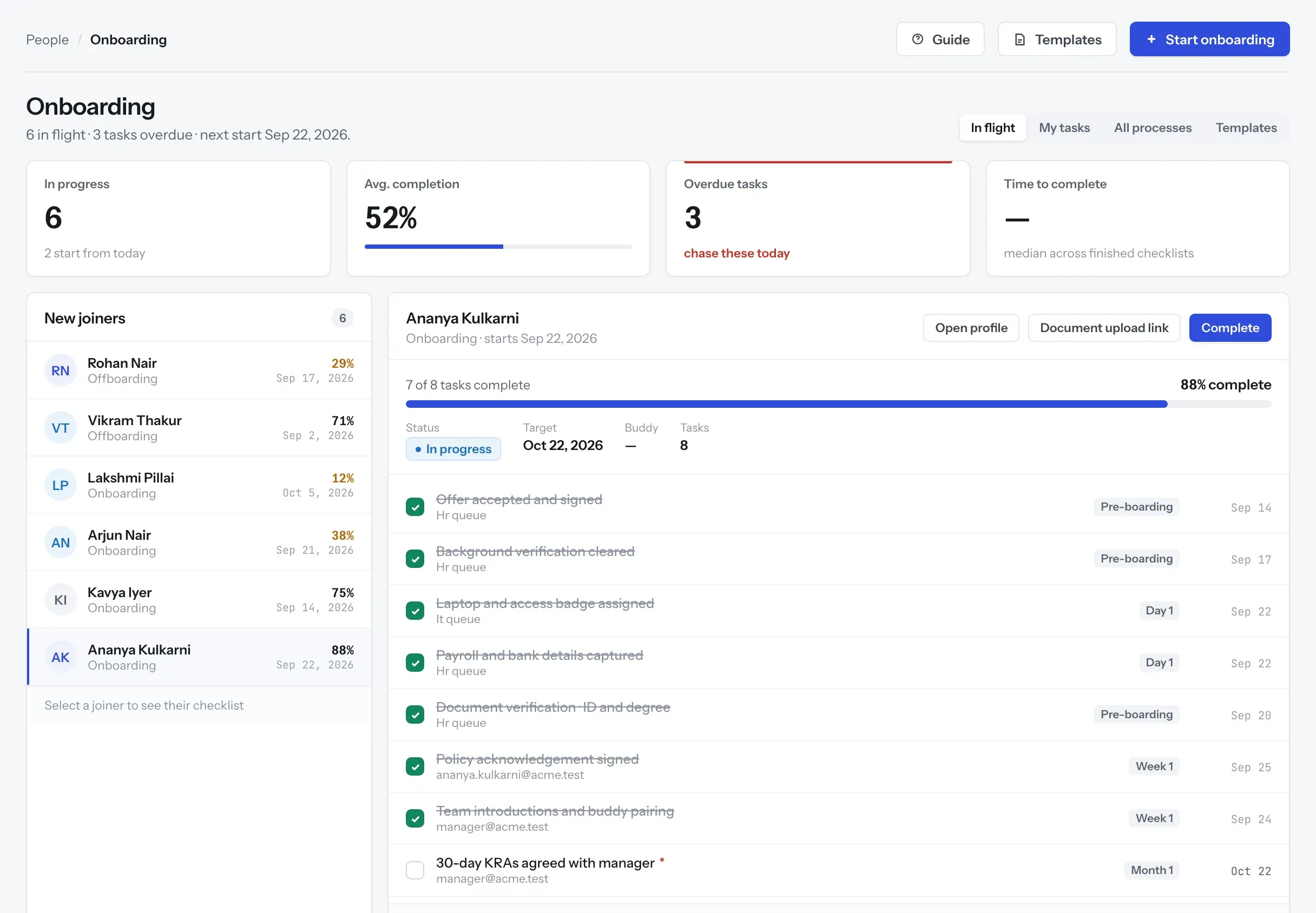
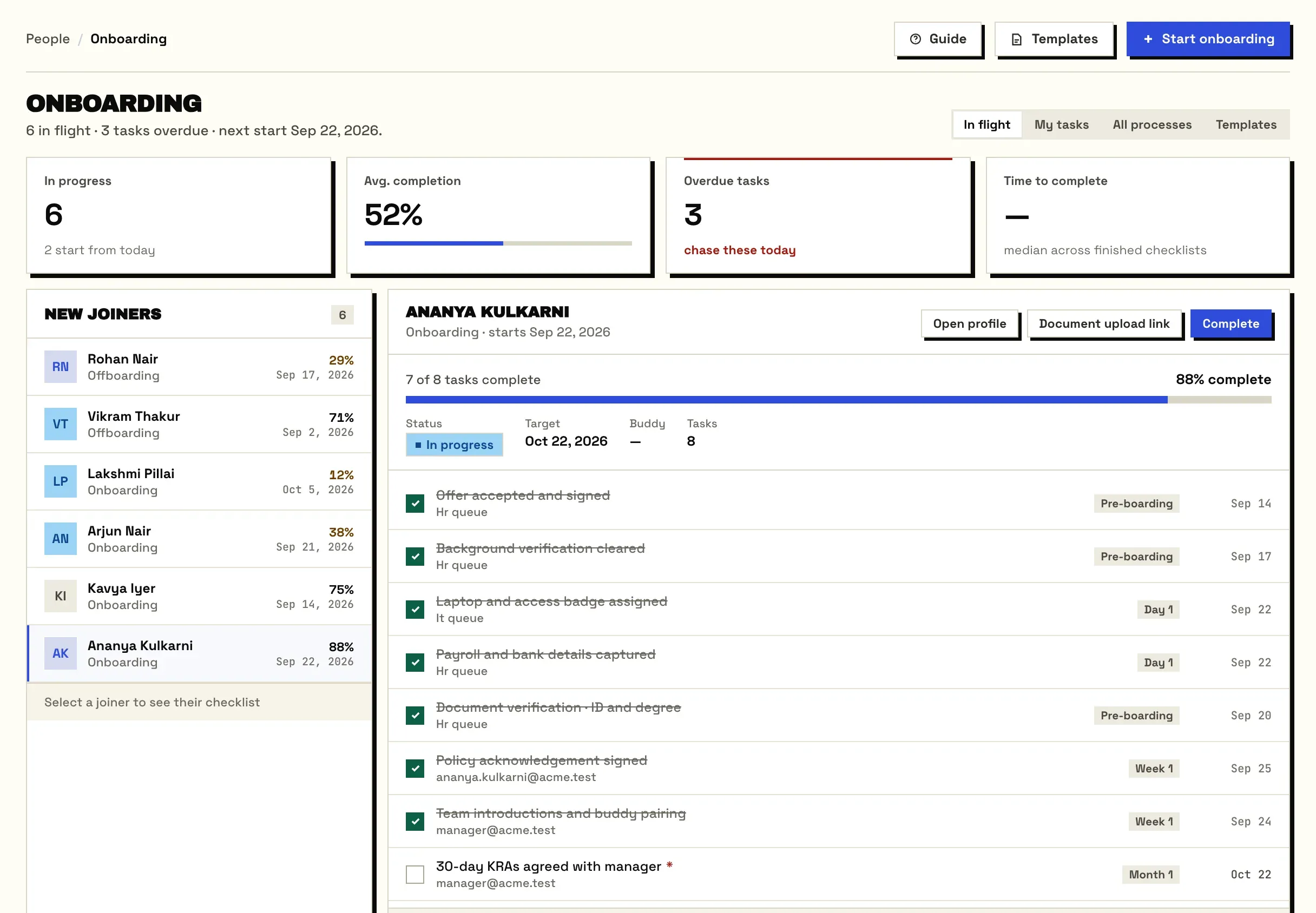
- 3Onboarding process startedFrom the department's template, each task due relative to the joining date
- 4Document link sentA signed upload link for the joiner, no account needed, valid for 14 days
What it connects to
Hiring is the front of the same record.
Recruitment is not a satellite bolted onto an HR system. It is the first four states of an employee record, run under the same permissions, the same approvals and the same audit trail as everything after.
People & org
The opening names a real location, department and designation, so the hire lands in the right place in the tree.
Learn moreOnboarding
The hire starts the process from the department's template, with each task due relative to the joining date.
Learn moreDocument collection
A signed link lists the joiner's outstanding documents and takes one file against each. It expires after 14 days.
Learn moreAudit trail
Every stage change and every conversion is recorded with the person who made it, like every other consequential write.
Learn moreIn the product
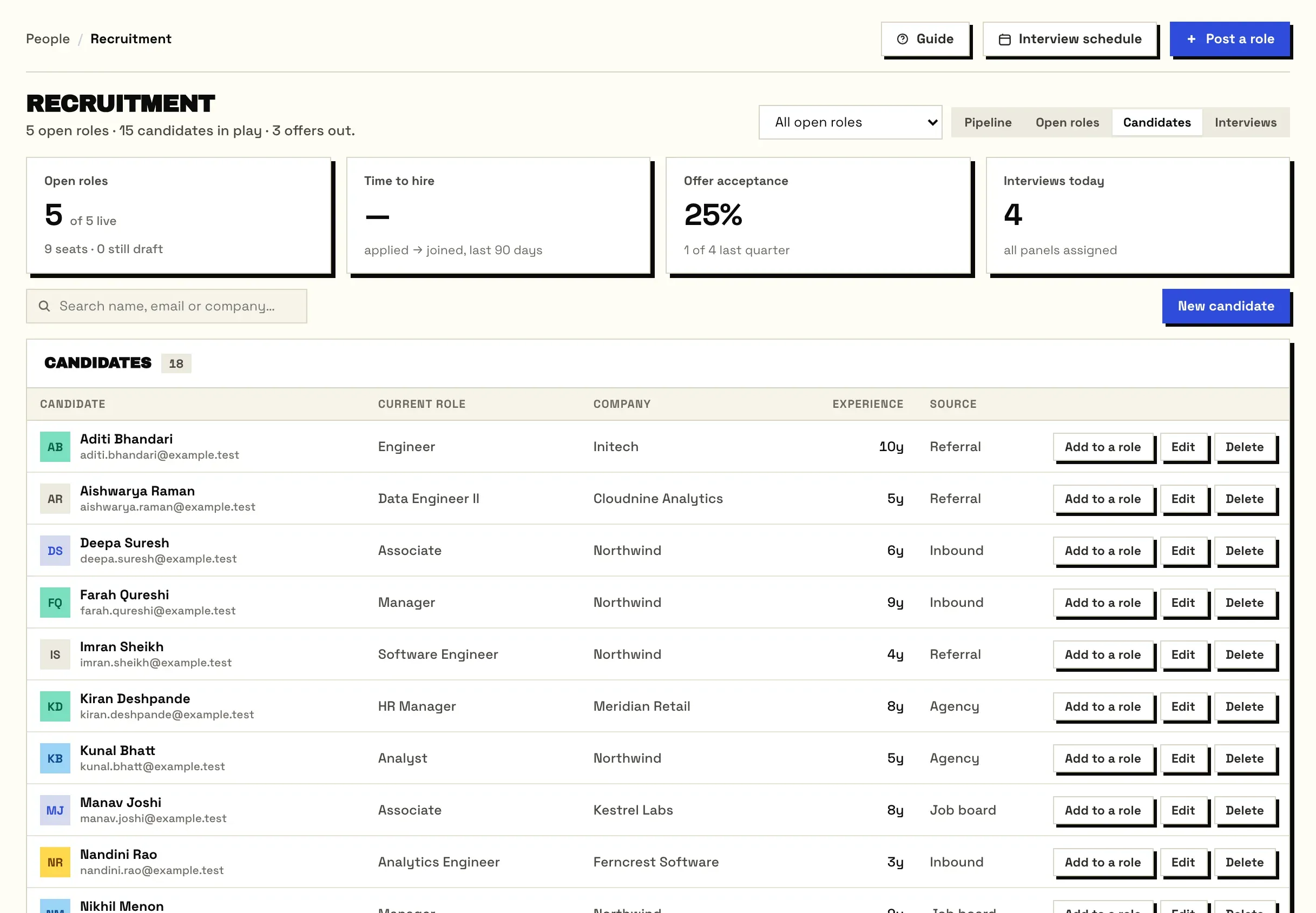
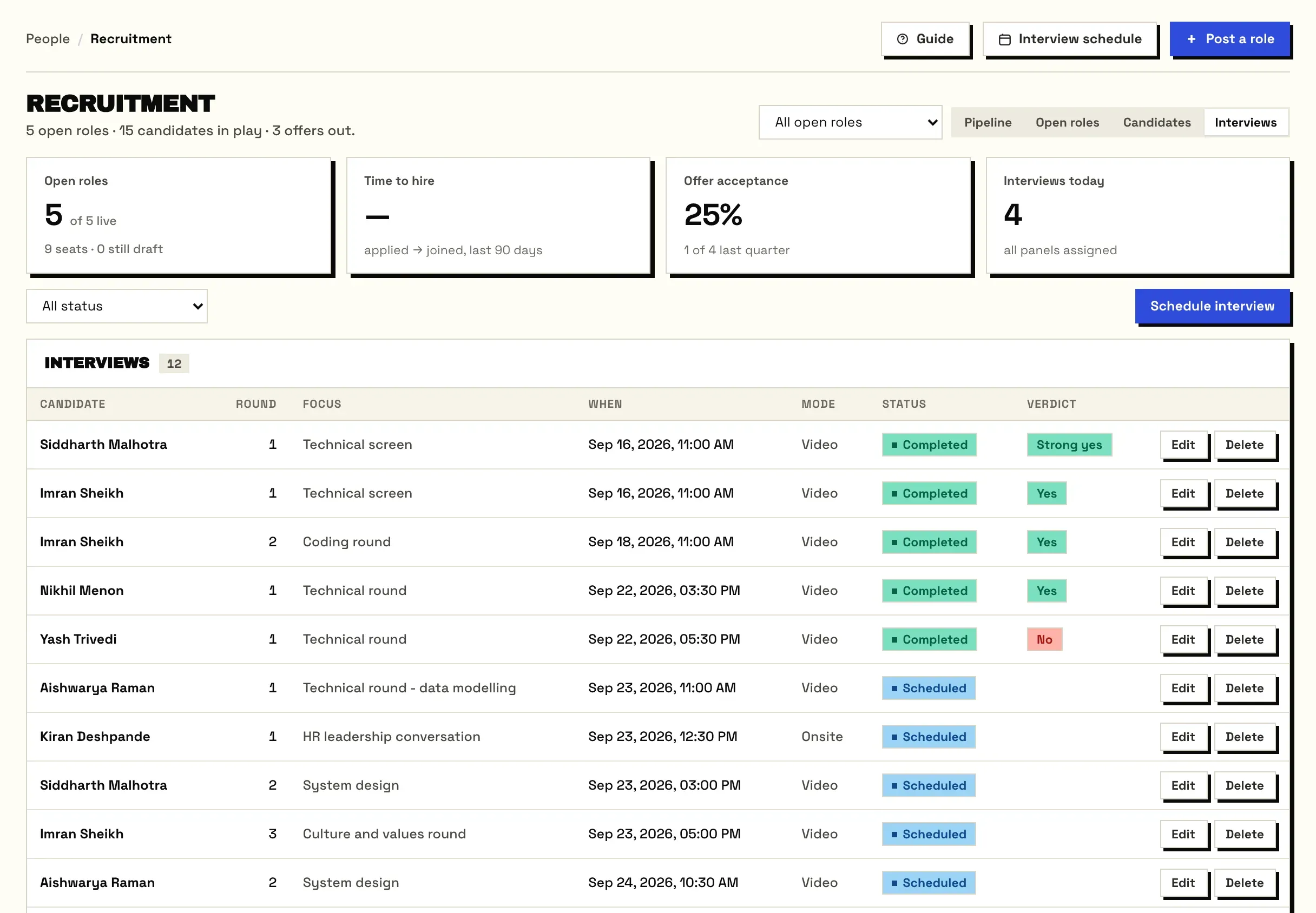
Roles, people, rounds, and the hand-off.
Offer letters
From offer to hire without retyping it.
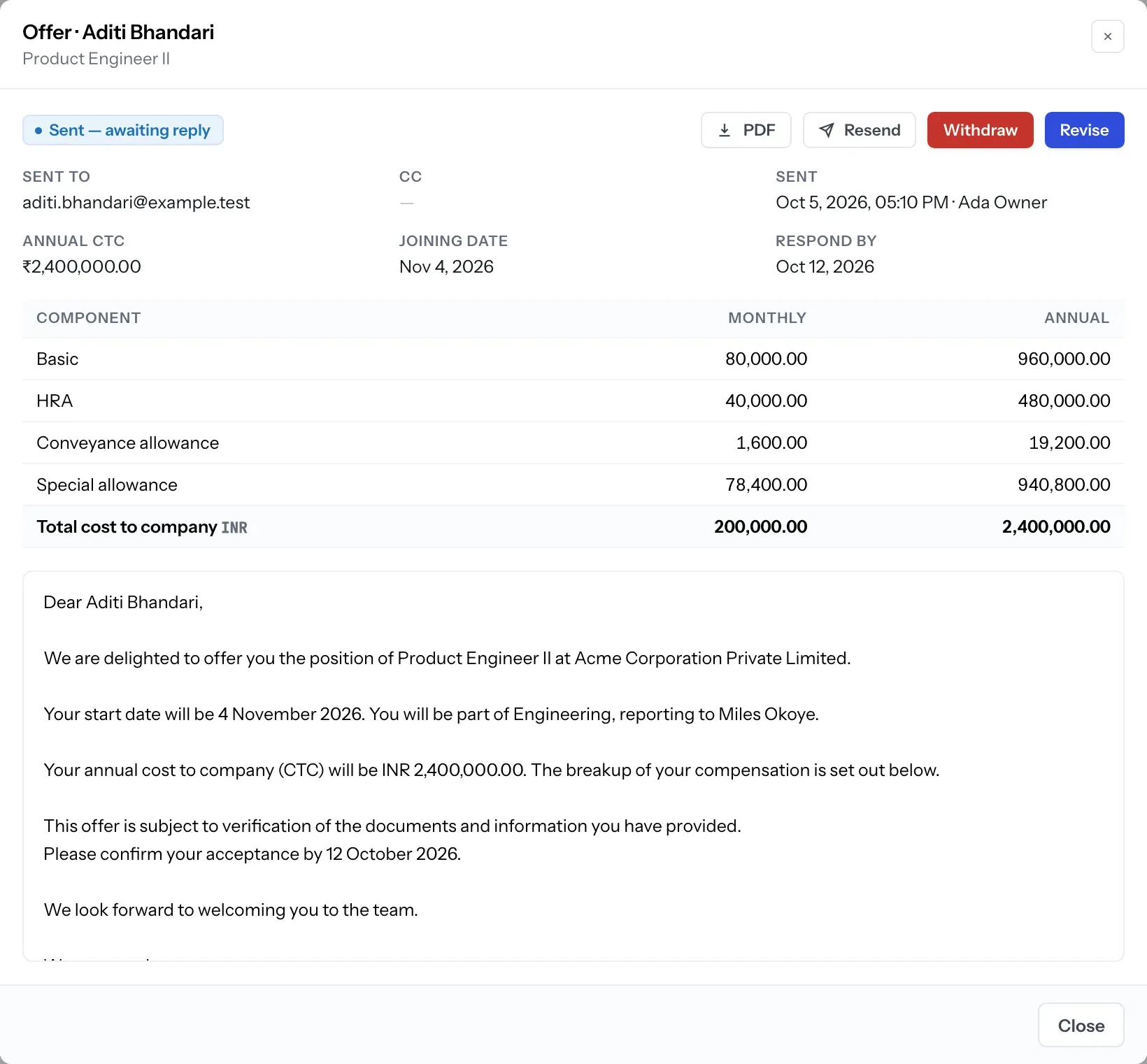
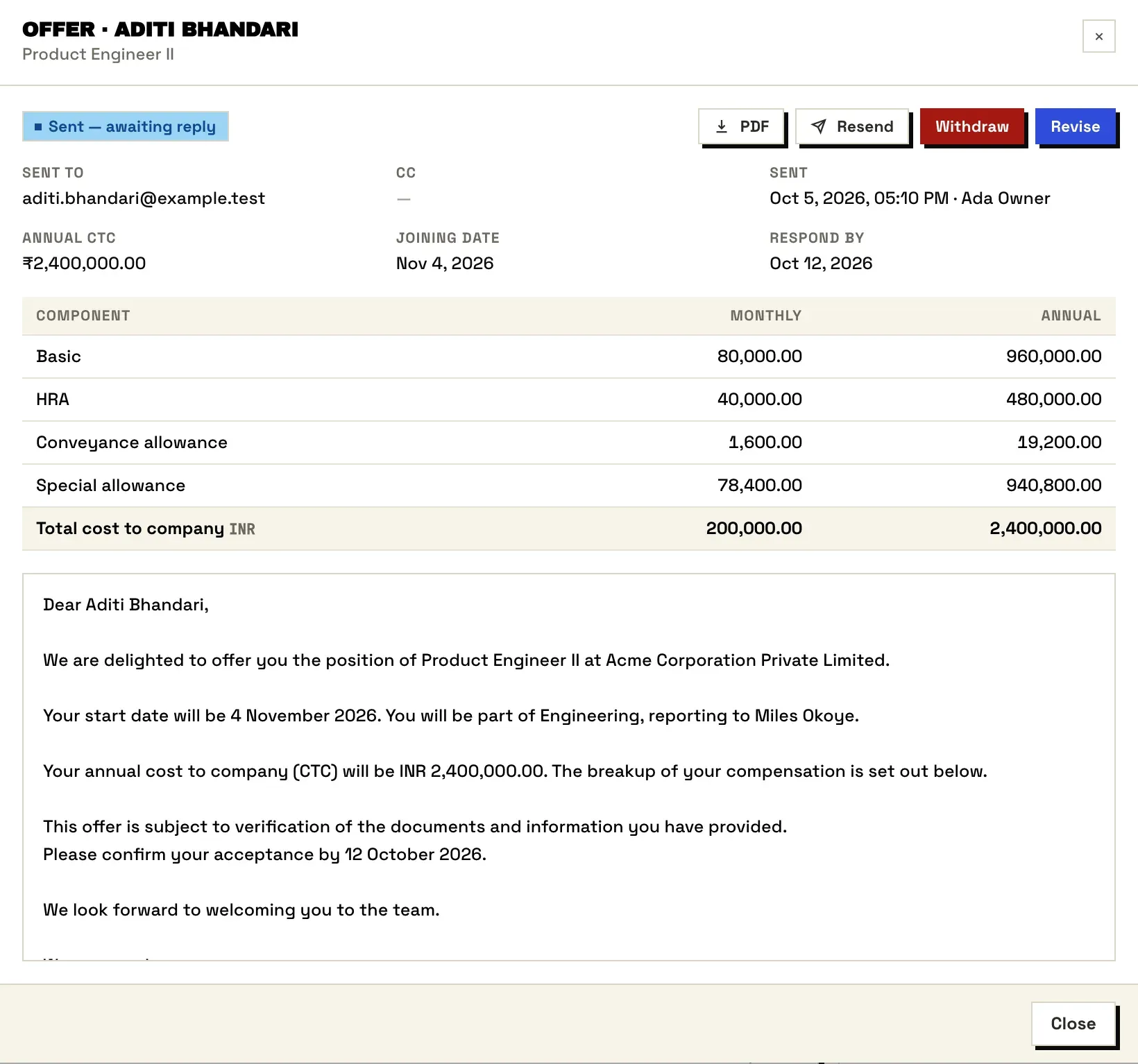
The offer is a document and a decision, both tied to the application that already holds the candidate's details.
Draft
The CTC is the only number you need to decide before you send. Price it against a salary structure and the letter shows the breakup, not just a total.
Send
The offer goes out as a PDF to any email address, built from the workspace's own letter template.
Respond
The candidate accepts or declines on a link. No account, no password, just a decision recorded against the application.
Hire
An accepted offer carries its designation, CTC and joining date straight into the new employee record.
Book a demo · 30 min
Watch an offer become an employee.
Thirty minutes with your openings and your interview rounds. We will take one candidate from applied to an onboarding process without retyping anything.