Money out, and
things you lent people.
Two jobs that always end up in the same two spreadsheets: what the company owes an employee for a trip, and which employee is holding a company laptop. Both are here, both hang off the same employee record, and both carry their own paper trail to the end.
Part one · Expenses
A claim that survives contact with an auditor.
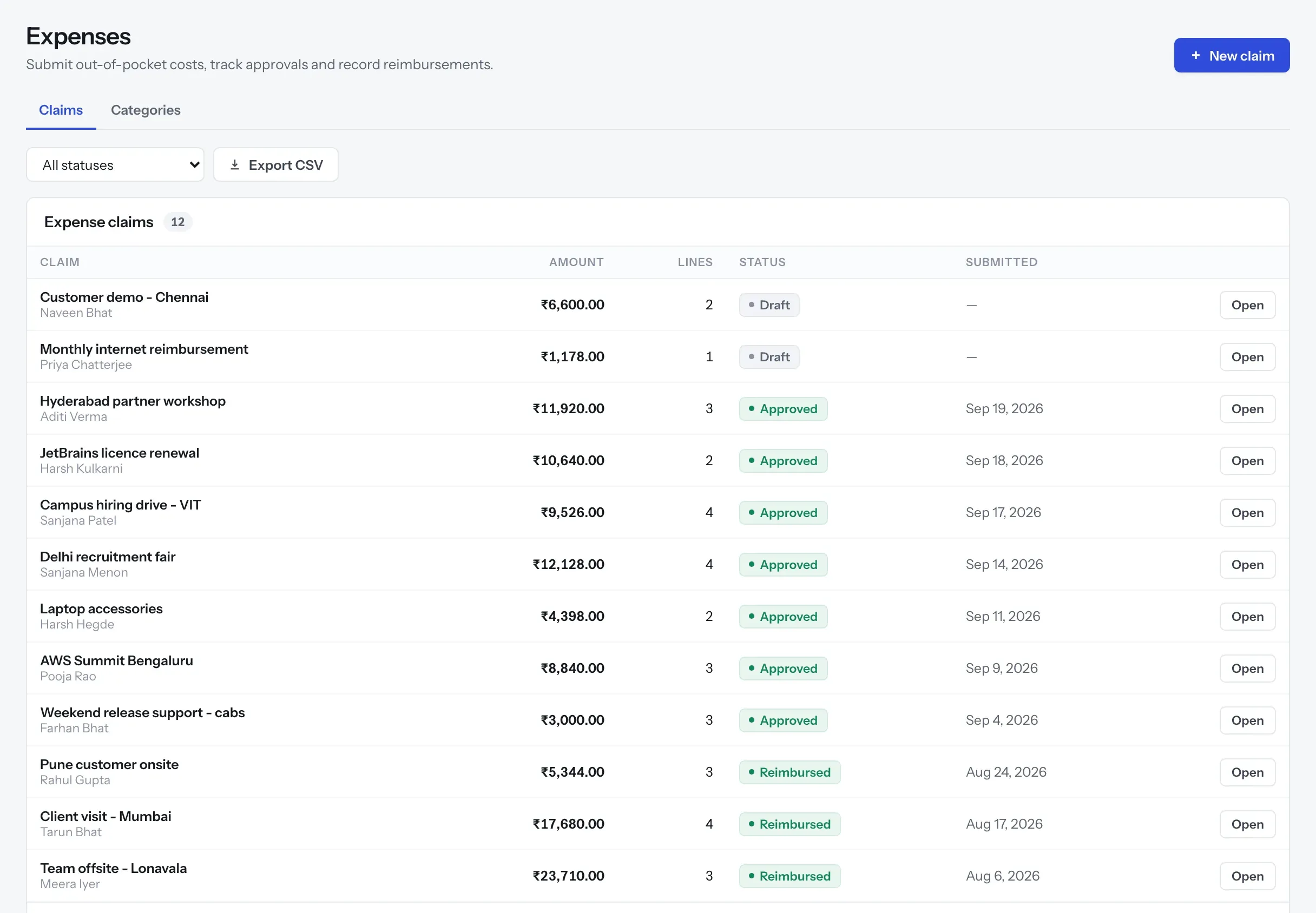
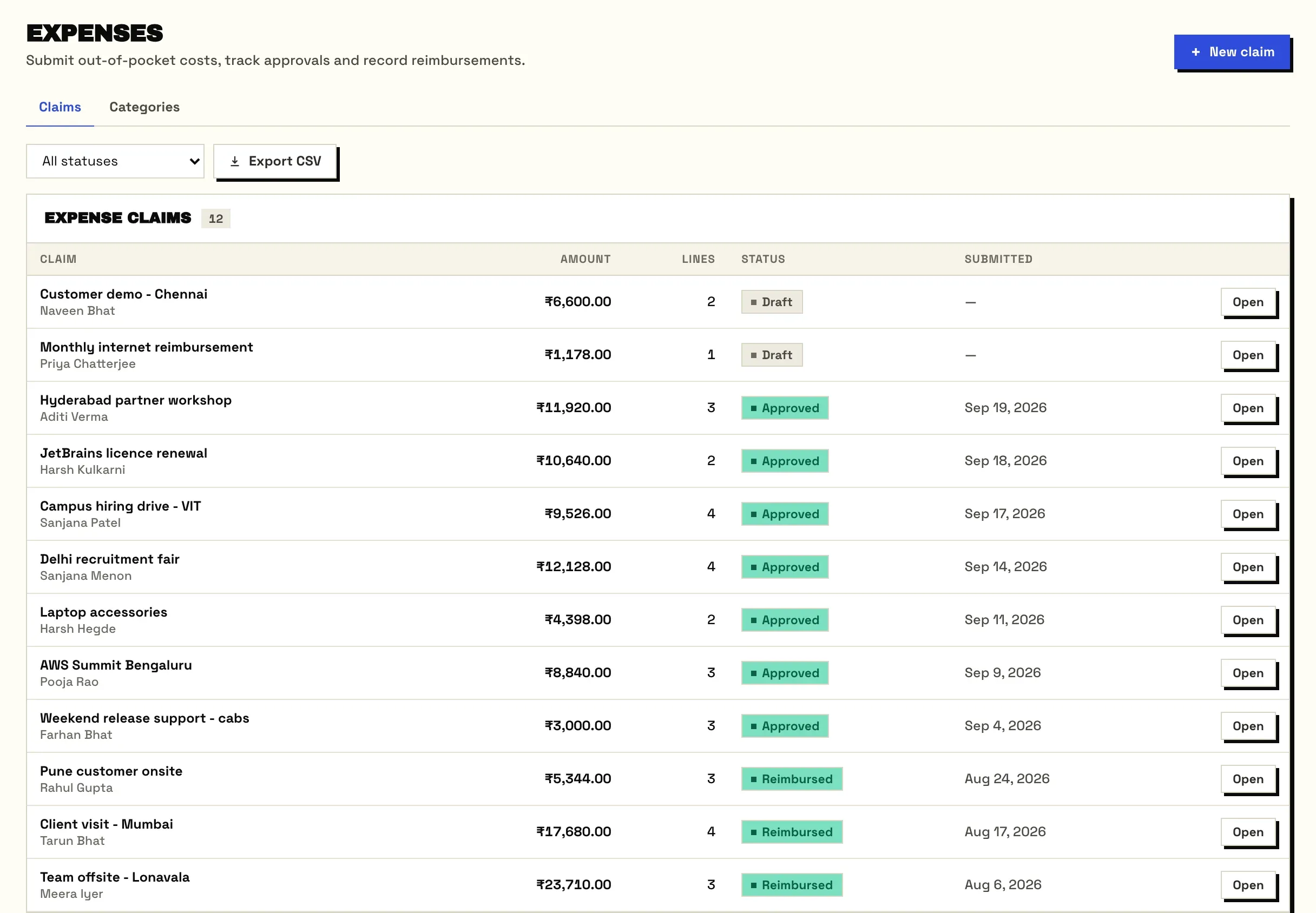
The failure mode of expense software is that it produces a queue of approvals and then hands finance a CSV to re-key. A claim here carries its lines, its receipts, its approvals and — once it is settled — the payment reference and date, on the one record that raised it.
Claims with line items
A claim is a header and its lines. Each line carries its own date, category, amount and receipt, so a trip is one submission rather than six.
Receipts checked by magic bytes
A file is validated by what it actually is, not by what its name claims. Anything a browser would render as markup is refused whatever it is called, and the size cap is enforced on every upload path.
Claimed and approved, both kept
The approver can approve less than was claimed. The claim keeps both figures, so the difference is on the record rather than in a reply-all.
Ownership frozen after creation
The employee a claim belongs to is set when it is created and read-only from then on. There is no edit that moves a claim onto a colleague.
Policy limits that are checked
A cap per claim for each category, a ceiling on units per line, and a receipt required above a threshold you set. They are rules on the category, checked on entry, not discovered in the audit.
Mileage and per diem, priced by the server
A rated category is paid per kilometre or per day. The employee enters the distance or the days; the server prices the line and ignores any amount the client sends. The rate is copied onto the line, so a later rate change never rewrites a settled claim.
Claim · Delhi client visit
In approvalAwaiting settlement. The payment reference lands on the claim itself.
Where the money lands
The claim carries its own settlement record.
Most stacks approve a claim in one place and pay it in another, so nobody can answer 'was I paid for the Delhi trip' without opening a bank statement. Here the claim moves draft → submitted → approved → reimbursed, and the settlement — amount, payment reference, date — is written onto the claim. The question is answerable from the record that raised it.
- Paid, with a reference against itWhen a claim is settled, the amount paid, the payment reference and the date are recorded on the claim. Finance reconciles against a reference rather than a memory.
- The same approval engine as leaveRequest, approver, decision, action, notification. Expenses did not get its own half-finished approval chain.
- A claim cannot be re-pointedEmployee, claim and category are fixed at creation. An edit changes the amount or the note, never who is being paid.
The laptop register
Somebody has the MacBook. The sheet says it was Rahul, in 2023.
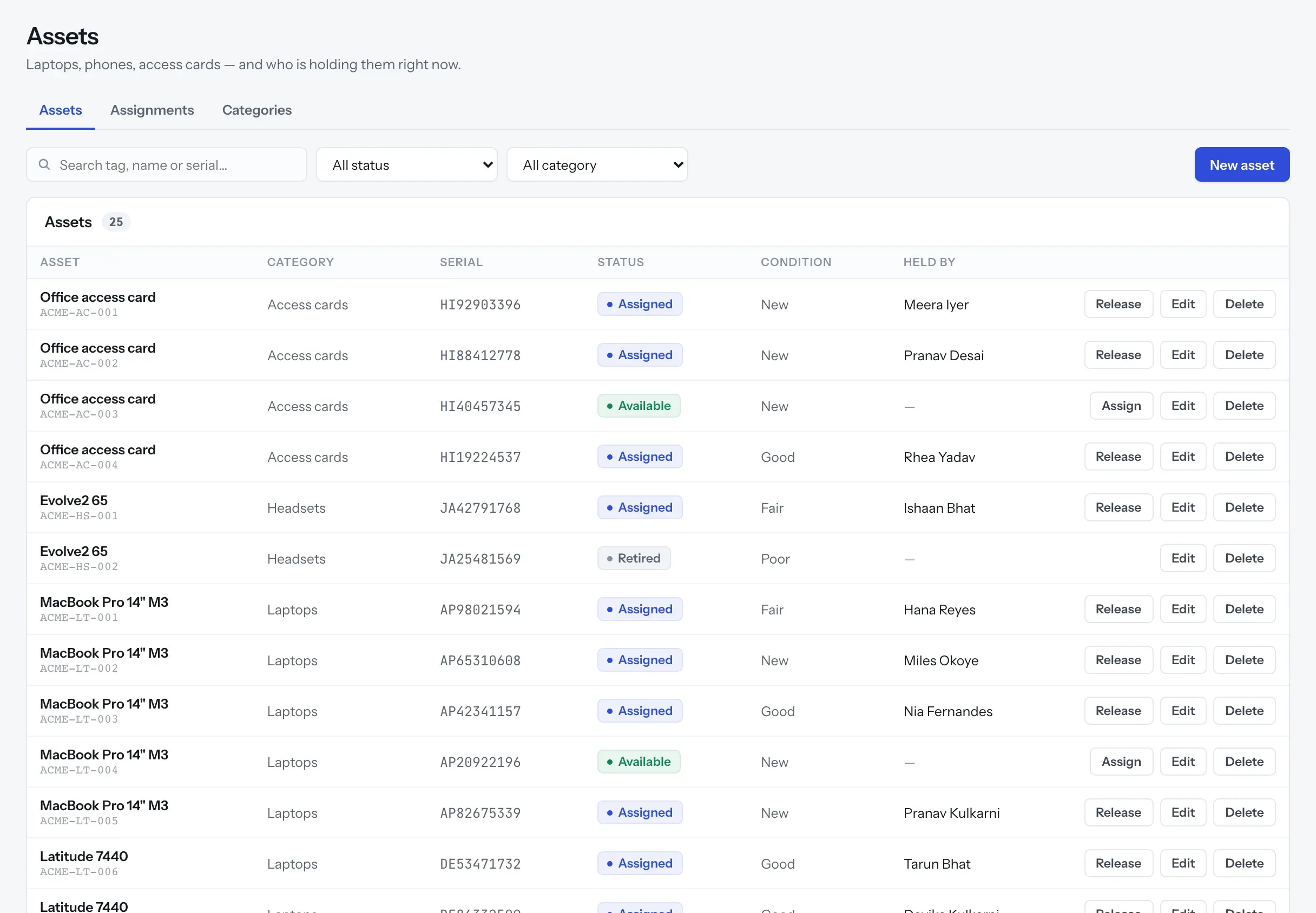
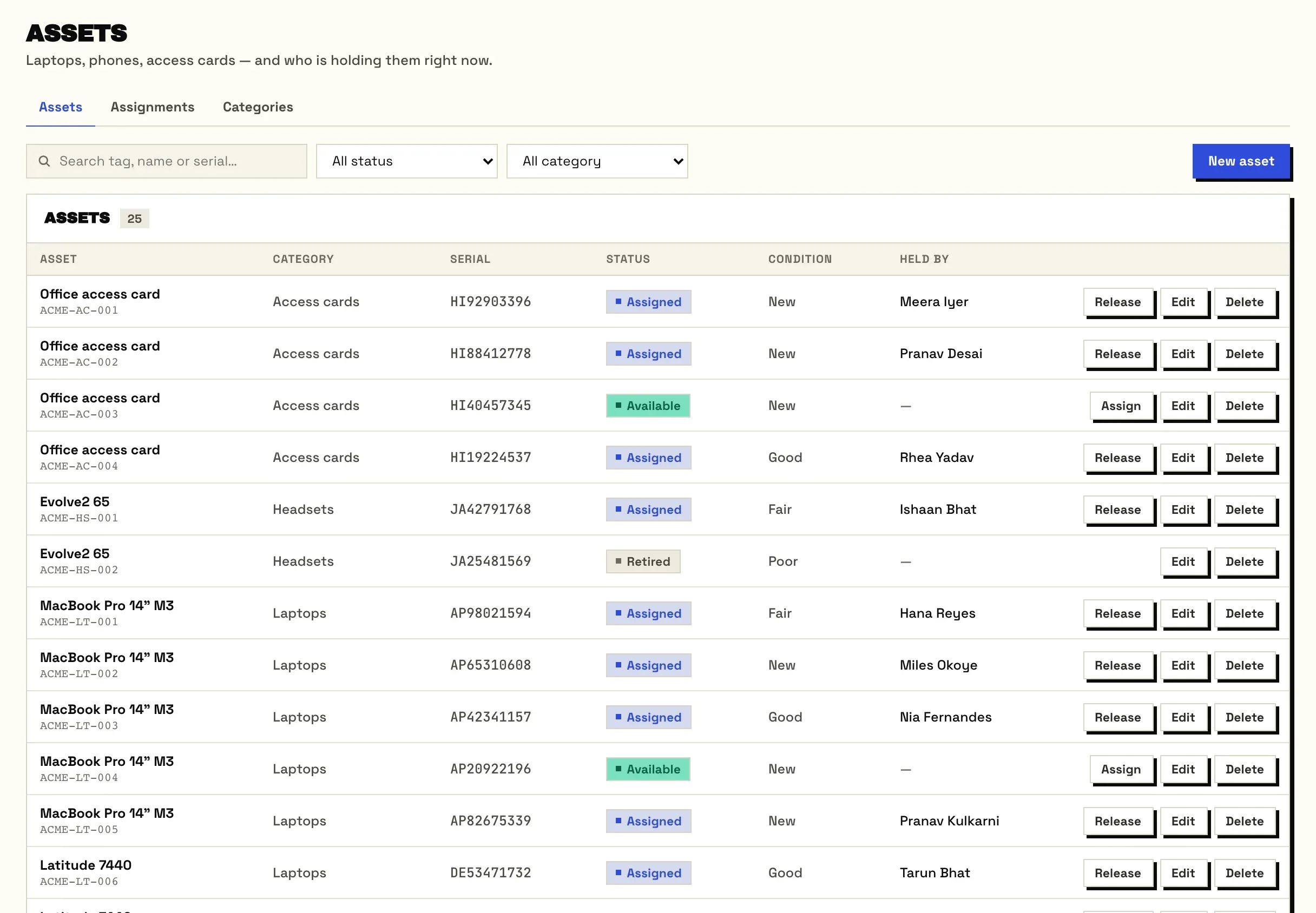
Asset tracking is the job everyone agrees should exist and nobody owns. It works here because it is not a separate exercise: the register is the same record the exit clearance reads, so a machine that is still out holds up the leaver's settlement until somebody decides what happens to it.
One register, not a spreadsheet
Every laptop, phone, access card and monitor with a serial number, a purchase date, a value and a current holder. The register is queryable, so 'who has the 14-inch machines' is a filter.
Assignment with a condition
An asset is assigned to a person on a date, by a named person, with its condition recorded going out and again coming back. Custody has an owner at every point in the asset's life.
Status and history
Available, assigned, in repair, lost or retired, with every past assignment kept. The history follows the machine, not the employee who happened to have it.
Return, before the last payment
Anything still assigned to a leaver becomes a mandatory item on their exit clearance, and the settlement cannot be approved while it is open. A missing charger is a recovery amount, decided on purpose.
Why they share a page
Both of them end at the last payslip.
An employee leaving has an unpaid claim and an unreturned monitor. In two systems those are two people's problems and neither of them is finance's until it is too late. On one record, the full-and-final settlement can see both.
Day one: handover
The laptop handover is a task on the onboarding plan and an assignment on the register, dated and with its condition recorded. Custody starts on a record rather than an assumption.
Learn moreLast day: nothing outstanding
Assets still out are a mandatory clearance item, and each department can block its sign-off with an amount to recover. Nothing reaches the final settlement unnoticed.
Learn moreAll year: an audit trail
Who approved which claim, when, and from where. Who held which machine, and in what condition it came back. Recorded as it happens, never edited in place.
In the product
Claims, and the register nobody wants to keep in a sheet.
Book a demo · 30 min
Bring your worst expense policy.
A per diem, a mileage rate nobody can find, a receipt rule finance invented in March. We will show you what it looks like as rules the system checks.